Showing posts with label Utah State. Show all posts

Friday, February 28, 2025

The Best Time to Prune Grapevines in Southwest Idaho

Pruning grapevines is an essential practice for ensuring healthy growth and a productive harvest. However, in regions like Southwest Idaho, timing is everything. Pruning too early in the season can expose vines to late winter freezes, potentially damaging buds and reducing fruit production. To maximize your grape yield and maintain vine health, it’s crucial to understand the best time and method for pruning in our local climate.

Why Timing Matters

Grapevines go dormant in the winter, making it a prime time for pruning. However, Southwest Idaho's climate presents unique challenges. While some gardeners may be tempted to start pruning in January or February, doing so can leave the vines vulnerable to unexpected cold snaps. If a sudden freeze occurs after pruning, exposed cuts and early bud development may be damaged, leading to reduced fruit production in the coming season.

The best time to prune grapes in Southwest Idaho is typically in late winter to early spring, around March, when the risk of deep freezes has diminished. By waiting until temperatures stabilize, you help protect your vines from cold damage while still pruning before the growing season begins.

How to Prune Your Grapes

  1. Assess Your Vine – Begin by evaluating the structure of your vine. Identify dead, diseased, or weak wood that should be removed.

  2. Choose a Pruning Method – The two most common methods are cane pruning and spur pruning.

    UNIVERSITY OF CALIFORNIA COOPERATIVE EXTENSION
    • Cane Pruning: Best for varieties that produce fruit on one-year-old wood. Select one or two healthy canes from last year’s growth and remove the rest.

    • Spur Pruning: Suitable for varieties that bear fruit on short spurs. Keep several short, two- to three-node spurs along the main cordon.

  3. Make Clean Cuts – Always use sharp pruning shears to make precise cuts. Cut just above a bud to encourage healthy new growth.

  4. Train the Vine – As you prune, shape the vine to ensure proper airflow and sun exposure, which help prevent disease and improve fruit quality.

  5. Monitor Weather Conditions – Keep an eye on the forecast. If a hard freeze is expected after pruning, consider providing some protection, such as mulching around the base of the plant.

Growing Grapes in Southwest Idaho

In addition to proper pruning techniques, successful grape growing in Southwest Idaho requires careful selection of grape varieties suited to the climate, well-draining soil, and adequate sunlight exposure. Proper trellising, irrigation, and pest management also play key roles in maintaining healthy vines and producing quality fruit. For further guidance on growing grapes in this region, including best practices beyond pruning, check out extension publications from the University of Idaho, Utah State University, and Oregon State University.

Final Thoughts

Proper pruning is key to successful grape growing in Southwest Idaho. By waiting until late winter or early spring to prune, you help safeguard your vines against freeze damage and set the stage for a bountiful harvest. Whether you’re growing table grapes or wine grapes, careful pruning will encourage healthy growth and improve fruit quality for seasons to come.

Sunday, June 7, 2020

Voles, friend or nuisance?

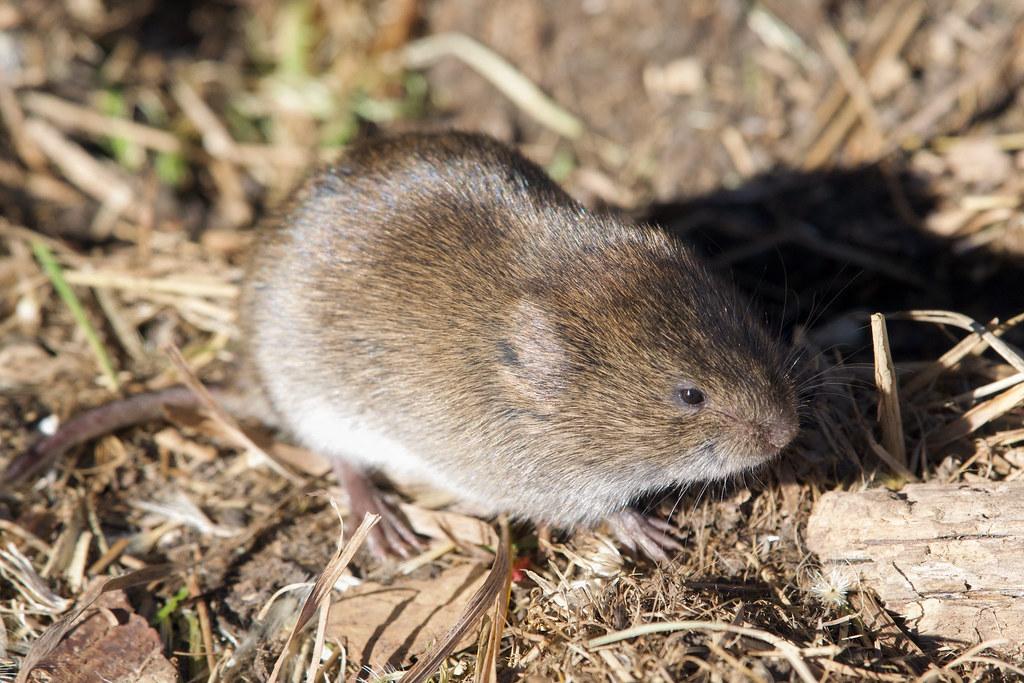
Voles are small rodents that measure 4-8 inches long and range in color from brown to gray.  In Alaska we had northern red-backed voles which are also found in Canada, Scandinavia, and northern Russia. They are sometimes referred to as Meadow Mice and their Latin name is Microtus pennsylvanicus.  “Microtus” translates to “small ear”.  They are pudgy with blunt faces, small eyes and ears, short legs and a short tail.  Vole numbers fluctuate from year to year and their populations can increase rapidly.  They can breed anytime of the year, but they typically breed in the Spring.  They are extremely prolific.  Female voles mature in 35 to 40 days, have 5 to 10 litters a year with 3 to 6 young per litter.
A rodent standing on a dry grass field

Description automatically generated
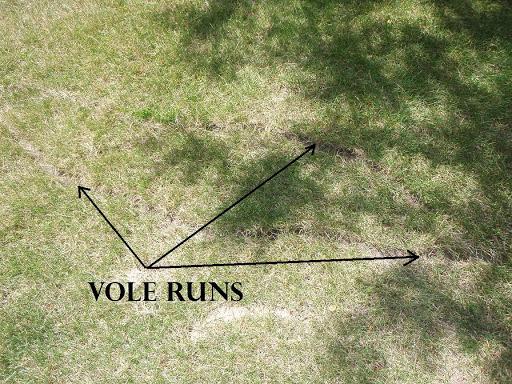
If you have turf, fruit trees, a home garden, grow crops commercially, and generally care about your landscape, you should be alert for the presence of voles.  They are herbivorous and feed on grasses, bulbs, tubers, tree bark, and tree roots.  They are active year-round, day and night.  A sure sign of voles “occupying an area” is their runways that connect numerous shallow borrows.  They don’t like to be seen and make their nest underground in dense vegetation and grasses and under snow in the winter.
A close up of some grass

Description automatically generated
It is best to mitigate vole population by use of a number of “management methods”.  One of the easiest ways to do this is to make your area less inviting.  You can do this by removing weeds, heavy mulch and dense vegetative cover.  This removes food sources, cover from predators, and makes it more challenging for them to connect trails.  This is generally referred to as “habitat modification”.  
You can also try fencing areas and adding approximately 12” of small mesh size (1/4” or smaller) to the bottom of the fencing  However, you would also need to bury the fence below the ground for 6-10” as voles tunnel.  
Protect young trees from girdling (removing the bark near the base) by using cylinders of metal, plastic, or hardware cloth and surrounding the trunk.  However, you also need to allow for tree growth and, again, remember to bury the cylinder below ground.  
If the voles have not “totally taken over the area” trapping can be effective.  A simple mouse trap baited with peanut butter has been successful.  Do not handle a caught vole w/o gloves as they do carry infectious pathogens and/or parasites.  Also, be sure to keep small children and pets out of the areas where you have traps set.
Finally, if you have a large area to eradicate and trapping will not be effective, there are two toxicants, zinc phosphide and anti-coagulants that are considered lethal control.  Please note, these are not recommended for residential areas.
Additionally, zinc phosphide is toxic to ground-feeding birds. Read labels carefully and contact your County Extension Office for further assistance!
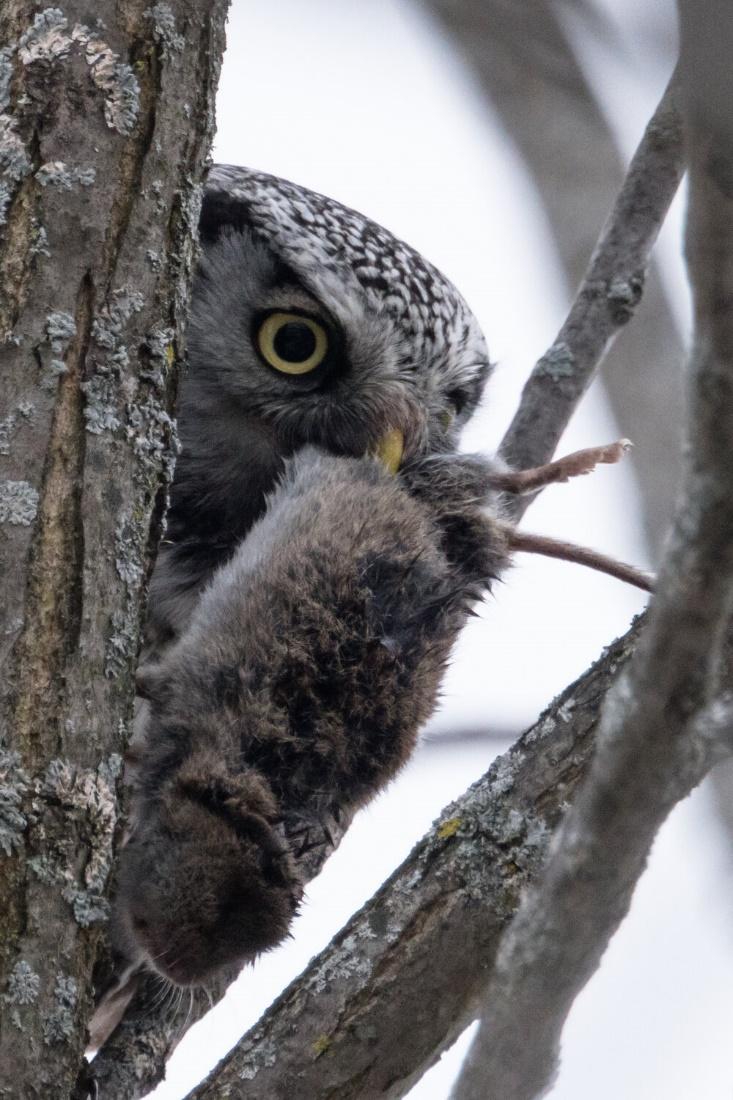
Bottom line, voles are generally pest.  However, ask a predator such as a coyote, fox, snake, owl or hawk and they would say they are beneficial! 
An owl perched on a tree branch

Description automatically generated