Showing posts with label University of Idaho Extension. Show all posts

Friday, February 28, 2025

The Best Time to Prune Grapevines in Southwest Idaho

Pruning grapevines is an essential practice for ensuring healthy growth and a productive harvest. However, in regions like Southwest Idaho, timing is everything. Pruning too early in the season can expose vines to late winter freezes, potentially damaging buds and reducing fruit production. To maximize your grape yield and maintain vine health, it’s crucial to understand the best time and method for pruning in our local climate.

Why Timing Matters

Grapevines go dormant in the winter, making it a prime time for pruning. However, Southwest Idaho's climate presents unique challenges. While some gardeners may be tempted to start pruning in January or February, doing so can leave the vines vulnerable to unexpected cold snaps. If a sudden freeze occurs after pruning, exposed cuts and early bud development may be damaged, leading to reduced fruit production in the coming season.

The best time to prune grapes in Southwest Idaho is typically in late winter to early spring, around March, when the risk of deep freezes has diminished. By waiting until temperatures stabilize, you help protect your vines from cold damage while still pruning before the growing season begins.

How to Prune Your Grapes

  1. Assess Your Vine – Begin by evaluating the structure of your vine. Identify dead, diseased, or weak wood that should be removed.

  2. Choose a Pruning Method – The two most common methods are cane pruning and spur pruning.

    UNIVERSITY OF CALIFORNIA COOPERATIVE EXTENSION
    • Cane Pruning: Best for varieties that produce fruit on one-year-old wood. Select one or two healthy canes from last year’s growth and remove the rest.

    • Spur Pruning: Suitable for varieties that bear fruit on short spurs. Keep several short, two- to three-node spurs along the main cordon.

  3. Make Clean Cuts – Always use sharp pruning shears to make precise cuts. Cut just above a bud to encourage healthy new growth.

  4. Train the Vine – As you prune, shape the vine to ensure proper airflow and sun exposure, which help prevent disease and improve fruit quality.

  5. Monitor Weather Conditions – Keep an eye on the forecast. If a hard freeze is expected after pruning, consider providing some protection, such as mulching around the base of the plant.

Growing Grapes in Southwest Idaho

In addition to proper pruning techniques, successful grape growing in Southwest Idaho requires careful selection of grape varieties suited to the climate, well-draining soil, and adequate sunlight exposure. Proper trellising, irrigation, and pest management also play key roles in maintaining healthy vines and producing quality fruit. For further guidance on growing grapes in this region, including best practices beyond pruning, check out extension publications from the University of Idaho, Utah State University, and Oregon State University.

Final Thoughts

Proper pruning is key to successful grape growing in Southwest Idaho. By waiting until late winter or early spring to prune, you help safeguard your vines against freeze damage and set the stage for a bountiful harvest. Whether you’re growing table grapes or wine grapes, careful pruning will encourage healthy growth and improve fruit quality for seasons to come.

Friday, June 7, 2024

Shrubs Native to Southwestern Idaho

 Interest in native plants continues to grow, and for good reason! Whether for water  conservation, wildlife habitat and food sources, or simply an adherence to local flora, gardeners and plant enthusiasts alike find themselves curious about native plants.  

Plants native to southwestern Idaho are evolved to withstand hot and dry summers, cold winters, periodic droughts, and infrequent wildfires. It should be noted that native plants  are not necessarily synonymous with Fire Wise plants, a type of plant selected to withstand fires. Native plants provide a critical food source and habitat for insects, small mammals, and birds. Native plants have adapted to be more drought tolerant compared  to nonnative plants. Below are five shrubs that are native to Idaho and well adapted to  the growing conditions of the Treasure Valley. 

Purshia tridentata (Antelope bitterbrush) grows to about 5-8’ tall and 4-6’ wide. The flowers of this shrub are small, bright yellow, fragrant, an appear in late spring. Bitterbrush serves as a critical food source to herbivores, especially during harsh winters. As the name implies, the seeds have a bitter flavor.
Artemesia tridentata (Basin Big Sagebrush)  grows 3-5’ tall on average in a rounded or irregular shape and flowers in September. Similar to many sagebrush species, this shrub actually produces two types of leaves: one that is deciduous and another that is persistent (or evergreen). The leaves produce an essential oil that repels some wildlife but attracts fragrant others, such as pygmy rabbits and Greater Sage-grouse, which are dependent on it. 

Artemisia tridentata ssp. xericensis (Foothills sagebrush) is a naturally occurring hybrid between basin big sagebrush and mountain big sagebrush. This shrub grows 3’  tall and flowers in September. One way to distinguish between this shrub and the basin big sagebrush is by shining an ultraviolet light on it when wet. Foothills sagebrush glows  a blue color, while basin big sagebrush does not.

Ericameria nauseosa(Gray rabbitbrush) grows to 2-7’ tall and 1-4’ wide and blooms yellow in late summer or early fall. This shrub is an excellent food source and habitat for small mammals and birds. While native, Gray rabbitbrush is, in fact, highly flammable.

Chrysothamnus viscidiflorus (Green rabbitbrush) grows up to 3’ tall and 1-2’ wide.
Yellow flowers appear in late summer. The Latin species name viscidiflorus means “sticky flowers” and refers to the pungent smell and sticky texture of the rabbitbrush. Green rabbitbrush is both highly flammable and capable of resprouting vigorously after fire. It is an excellent food source, especially to rabbits.

Native shrubs play an important role in Idaho’s ecosystem as they are uniquely adapted
to the growing conditions and provide an important food source and habitat for a variety
of animals. Here's a good list for more info.

Saturday, April 20, 2019

Spring Soil Prep - What you can do Now! (or as soon as the ground thaws :>)

The best way to begin preparing your soil is with a soil test. 
Your local University of Idaho Extension office can help you with this. This test is a great place to start because it tells you what to add to your soil to help your garden perform better. 
soil sample probe
Organic soil amendments also provide an important source of nitrogen for your plants.  Till or turn under with a spade 3-4 inches of compost into your soil at a depth of 6-8 inches and rake your bed smooth.

With a soil sample probe, the task is much  easier... and worth the cost - since you'll probably check your soil many times over the years.

This video shows how to gather your soil sample.

The most important thing you can do for your garden’s soil is to add organic matter. Organic matter aids in drainage and minimizes soil compaction, which reduces soil oxygen.


When choosing an amendment, consider carefully what you use. Animal based products and bio-solids are high in salts and heavy metals which build up in your soils. Consider using well aged plant based compost instead.


Now...check your plant temps, and frost days and...enjoy planting! 


Monday, October 22, 2018

Troubles with your Summer Lawn


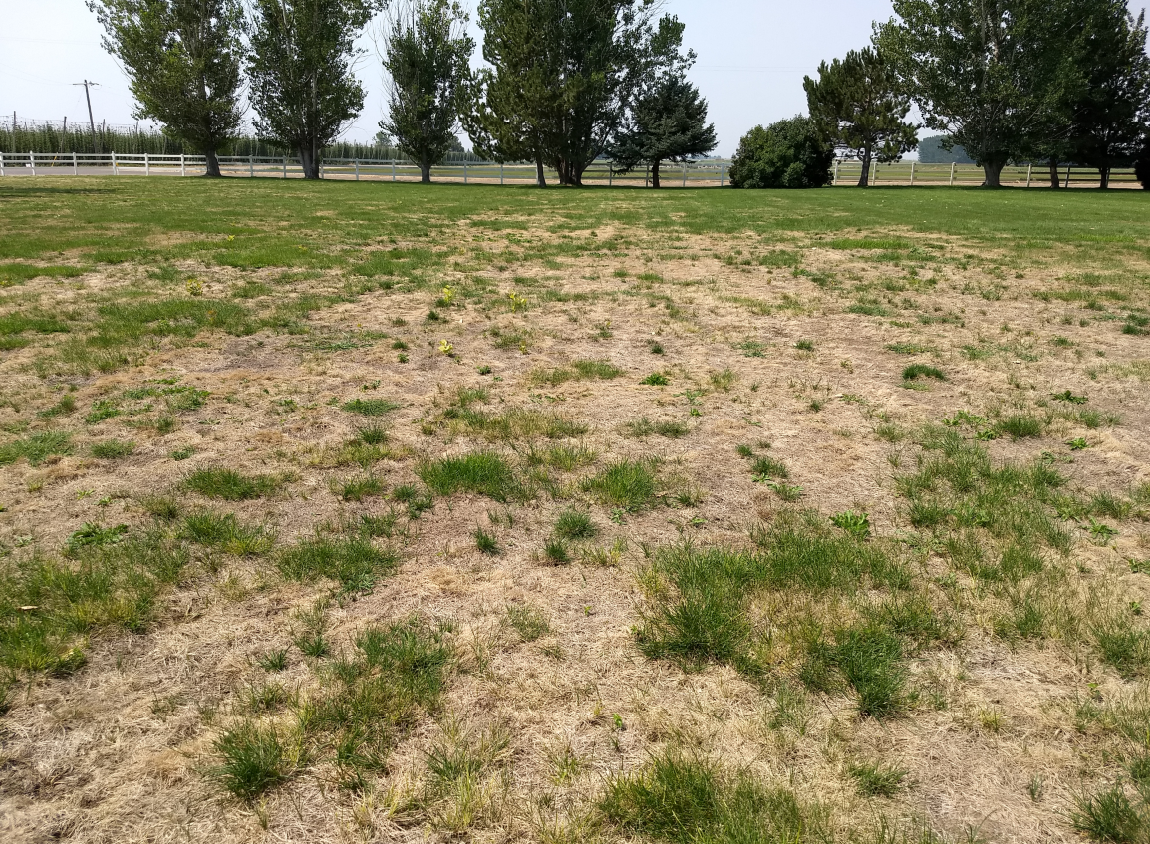
The Turf/Tree Team recently had a couple of site visits where our clients are having issues with their lawns. The 1st was fungal issue called Brown Patch, where the grass looked dead and the 2nd issue was an over watering issue where it was impacting his lawn. We also believe the over watering was also impacting the surrounding trees that were under stress. We’ll cover both issue and talk about how to avoid these problems going forward.


Let’s look at Brown Patch impacting a large area of the local neighbors lawn:
    
      No insect problems, just a fungal issue.


Our client swore she was having insect problem, but after we pulled up a large sample of the impacted lawn and took it back to office for analysis. We found both the crown and roots to be intact,  we also found no insect issue, because most insects such as billbugs would be eating away on roots and crown.
What we did find was good soil full of worm eggs and casting and a lot of small roly-polies. The grass though was thin with large patches of light brown grass. Our client had many unfavorable conditions that were going on from overwatering, from causing humidity levels to spike, to having a lawn service come out for multiple fertilizer applications to her lawn. All this added up for a severe case of Brown Patch to develop.  
So we followed up by researching from multiple educational websites that address Brown Patch and how to prevent Brown Patch from happening next year. Those articles included attention to cultural practices, such as avoiding excess nitrogen during the summer heat, which can contribute to reducing disease pressure and help improve fungicide performance on intensively managed turf. Improving air circulation and scheduling irrigation times to avoid long dew periods to also help suppress Brown Patch outbreaks.
There are also numerous effective fungicides that are registered for Brown Patch control. When selecting a fungicide, be aware of other turf disease threats and apply fungicides for these threats at the same time to minimize costs and other potential disease problems.


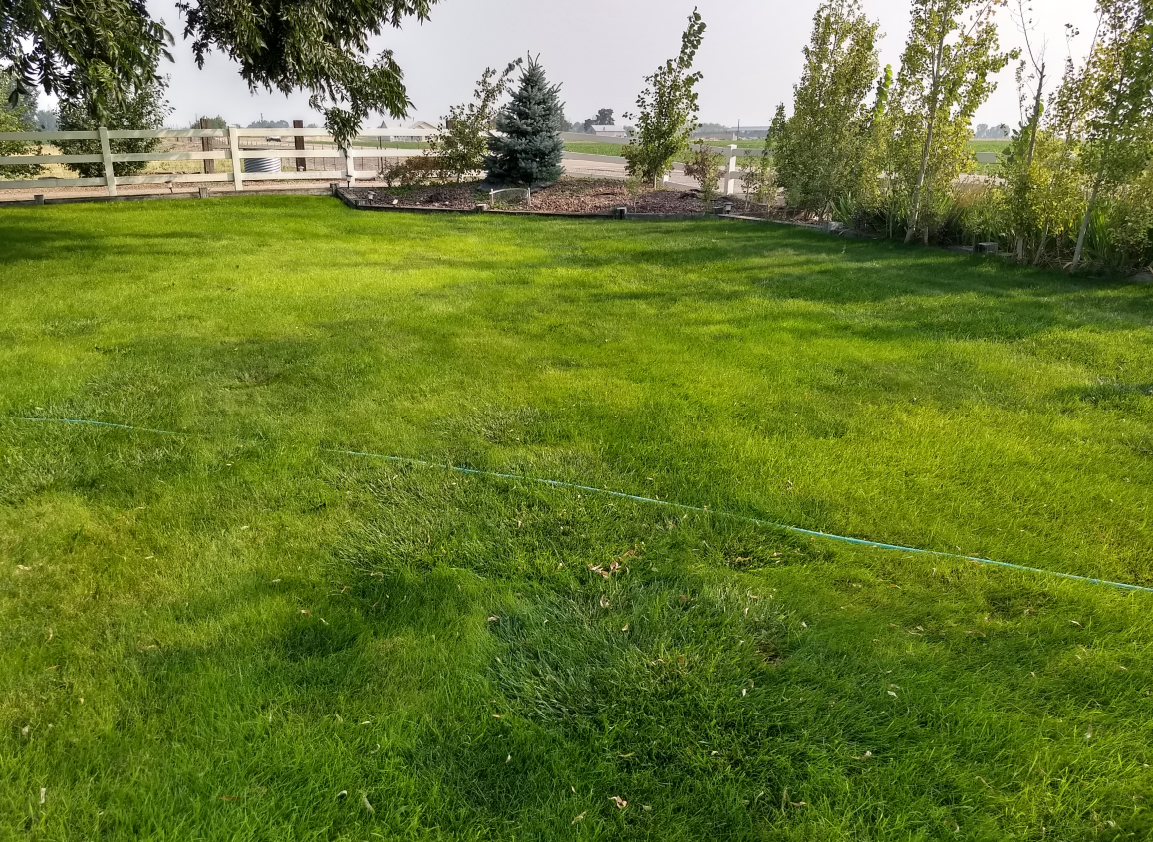
Our next site visit took us out to West Caldwell where the client was having what appeared to be dieback on multiple trees such as Ash, Pecan and Willow. At the time we didn’t have a answer for his tree problems. But after walking around his lawn area looking at the trees, we notice how soft and spongy the lawn felt. Looking around closer, we found large areas of yellowing grass and when we bent over and tugged at the lawn, we felt the crown area separating from the soil surface. We then ask about his watering and fertilizing schedule. We found out he was watering for nearly hour in each zone every other day and his local lawn care service was out frequently applying multiple applications.


          Light Yellowing of grass blades


We talked for awhile about how much water his lawn really needs during the summer months and that his lawn care service may be over doing it. He did turn off the watering station to allow his lawn to dry out some while we were there.
When we got back to office we followed up by putting together a Lawn Maintenance Schedule that included how often to water and what his lawn fertilizing needs were for a whole year. He seemed pretty happy with the follow-up schedule. We also sent an older article we found from USDA where over applying the amount of Nitrogen could be causing problems with his Pecan tree. Even though I wouldn’t rule out the 3 story tall tree house surrounding the pecan tree, it may also be impacting on the life of tree.

So far this summer the Turf/Tree Team has been fairly busy with site visits and providing research based answers to the clients. They have enjoyed the opportunity to provide this service which is part of the Master Gardener Program, Canyon County Extension of the University of Idaho.


Wednesday, September 26, 2018

Growing Good Kids: Junior Master Gardener Program NOTE: schedule for spring 2019 (february?)


Dig In! Let's get Growin'
Level I Mascot
Fun and educational gardening activities for Kids!


What is the Junior Master Gardener Program?


"The Junior Master Gardener program is an international youth gardening program of the University Cooperative Extension network. JMG engages children in novel, “hands-on” group and individual learning experiences that provide a love of gardening, develop an appreciation for the environment, and cultivate the mind."  (jmgkids.us)  The curriculum is designed to facilitate teaching life skills, math skills, observation skills and social skills through ecology, gardening, reading, and leadership.
How does the program work?

The curriculum offers two levels: elementary (Level I) and middle school (Level II).Level 1 (elementary children) Level 2 (middle/jr. high students) http://jmgkids.us for curriculum and website.
Because the JMG materials are creative, well-researched, horticulturally robust and readily available through the Texas A&M University Extension, the materials have been used by a wide range of people and organizations. They are considered a treasure trove of experiential gardening activities, its applications seem limitless. (Fleming)

In Level I, The Literature in the Garden Module features award winning books!
The 2018 Growing Good Kids Excellence in Children’s Literature Award Winners were announced at the National Children & Youth Garden Symposium on July 13, 2018 at Cornell University. http://jmgkids.us/bookawards/

Always a favorite among all age groups: Tops and Bottoms by Janet Stevens on you tube

Who can participate? Any children's activity groups: 4-H, after school, in school (the curriculum is approved for state standards), nature field studies, gardening clubs, home-schooled children, library programs, wildlife centers, faith-based groups groups. The possibilities really are limitless!


Decorated Potted Grasses
Community Garden Activity
In 2008, the Canyon County Extension Master Gardeners sponsored events at the Middleton Community Center, Nampa Public Library, Veteran’s Therapeutic Garden, Trinity Community Garden, and the Canyon Hill Community Garden. Over 250 youth participated!


*
Mr. Thistle
Level II Mascot


For more information contact:

University of Idaho Canyon County Extension 208-459-6003
or
http://jmgkids.us for curriculum and website

"The terms, Junior Master Gardener, JMG and Golden Ray Series, and associated logos, are service marks of the Texas A&M AgriLife Extension Service."


Sunday, April 29, 2018

Master Gardener Plant Clinics

What is this plant?
Is this a good or bad bug?
Have you ever seen a flower or weed or insect and wanted to know what it is? Or ever had your lawn or favorite plant/tree/bush suddenly start looking sick and wanted to know why?
You may not realize it, but expert help may be right around the corner!  
Starting on April 30, hours are Monday 1-4, Wednesday 1-4, and Friday 9-12.


Plant clinics take place at many locations around the area. Many are held at the County Extension Office while others may be at the local nursery or garden center, or at your community farmers market.

Idaho Master Gardener volunteers are trained to help you in plant and pest ID as well aiding in diagnosing what is wrong with a sick plant, tree, bush or lawn. 
For more information about becoming a Master Gardener volunteer or to contact our Plant Clinic, contact your local University of Idaho Extension office!


Wednesday, March 28, 2018

Planning For An Established Garden


Maybe you recently purchased a new home with existing plants, or you’ve finally decided to tackle that project of making your yard less of an eyesore.  Those plants were there before you were, and you really have no idea what they are or where to start? Or, maybe you even planted some of them at some point, and you thought you would remember what they were, but life got busy and you had several other things to remember.  Suddenly the name of the perennial Aunt Martha gave you 10 years ago as a housewarming gift is not one of the things you recall.

If it’s the first year in your home or just the first year you are actively paying attention, the best thing to do is to slowdown and start a journal of plant notes.  That may sound like a tedious project in itself, and in your mind taking out every plant and starting fresh sounds less like a root canal than a journal of plant notes. Here's a video about garden journaling.  However, ripping out your entire landscape is equivalent to burning down your house because it hasn’t been cleaned in a long time, and it’s a lot more work than you might anticipate.  It’s likely that project will also wind up partially completed, and you’ll have an overgrown bed adjacent to a bare naked bed.  If you do actually pull everything out, you’ll forget you haven’t decided what you’re replacing it with, and each trip to the nursery to pick out plants will remind you how expensive those replacements are which could mean completion takes longer than you expected anyway.

For the first year, you’ll want to keep a plant journal of each season.  Keeping a gardening journal doesn’t mean you are at a standstill or you aren’t making progress toward the yard of your dreams.  Don’t worry about not doing enough, because you can always clear leaves and anything you are positive is a weed, and that will keep you busy year round. 
The plant journal is a great place to record what you have now and also to brainstorm what you might like in its place or in addition.  Otherwise, you’re likely to plant on top of something that is already growing there and just hasn’t shown itself yet.  It may be a good time to pull out the plat map of the property that came with your title report when you purchased your home because it can be provide a good map of the property.  Or you can make your own map of the area in your journal. 

Take photos of the garden at different times of the day as well as different seasons, and keep them in your journal.  You may want to label each photo with the type of plant or care that is necessary to keep it healthy, but to start at least keep photos with your garden notes so you can remember the changes.  You’ll also begin to notice some areas of the garden that don’t fill in and need to have something planted there.  Or, you may discover taller perennials located at the front of the bed, when they should be in the back so they don’t cover up everything behind it.

You’ll also want to start identifying what you already have to keep a master plant list, and see how that plant is doing in its current location.  It may be that when it blooms you decide you love it and won’t want to remove it after all, but you realize it’s overgrown or just not quite resembling the photos of what you think it could look like.  It may mean you relocate the plant to another area of the yard where it does better, or maybe it needs divided or trimmed.  You can use perennial finders online  to help identify plants, or download the app for tree identification leafsnap   to figure out what trees are in your yard.  Of course, for one-on-one assistance, your local University of Idaho Extension Office. can help you identify plants and trees and provide tips to caring for them also.
 
After you’ve survived 4 seasons, you’ll start to have an idea of what you like and dislike about your existing plants.   You’ll be able to decide which ones you dislike or what you might change about the location.  Plus, you’ll have seen so many plants at this point in your plant identification search that you’ll start to have your own ideas about what you would like.  You may have already written down possibilities and then selected a plant that will do well in that location as well as what you find attractive.  In the end, your garden is ever evolving and changing, but a little planning will make the actual planting a lot less painful. For even more how-to information, check out this article.