Showing posts with label Amy Herber. Show all posts

Monday, September 18, 2023

What Pollinators Need in the Fall

Fall flowers for pollinators
 Pollinators Feed Us as We Feed Them Now is a critical time for Pollinator Bee Care! Here's what we need to do to keep the bees and the butterflies in our garden and help them prepare for winter.

Give Them Food.  Plant many different colors of flowers and different shapes and sizes to increase pollinator diversity.  Provide a variety of blooming plants throughout spring to fall.  Of particular importance are early spring blooming plants because they provide an immediate food source after the long winter.  Plant a variety of annuals, perennials, and flowering trees and shrubs. Late summer and early autumn (end of August through October) are very important periods for the production of adult worker bees that form wintering clusters in their colonies. Click the picture caption for more.
Make a Bee Hotel.  Your bee hotel might be as simple as a couple holes in some untreated wood or something more decorative and elaborate. - build one.  The bees won’t care what it looks like as long as it’s sheltered from too much sunlight and the elements - mainly moisture.  Or leave an area of bare dry soil or a brush pile to encourage ground nesting.  It doesn’t have to be unsightly.  An area behind a shed or out of the way so it’s not as noticeable will do wonders to attract bees.  Just make sure it’s in an area that doesn’t have a lot of human interaction so bees will be encouraged to stay.
Plant Native Species.  Plant different flowers, shapes, sizes, colors, and group together in a sunny location.  By planting in groups, you’ll provide the nectar all in one easily accessible area.  Native plants not only survive more easily than non-native plants, they attract more pollinators.  
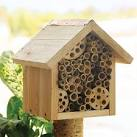
Open face roofed wooden shelter for bees
Bee Hotel
Avoid Pesticides.  Sometimes we rush to use a chemical as a quick-fix instead of realizing a plant that is stressed needs a diagnosis.  Your local extension office can help determine the problem with your plants so bring your sample in, and if detected early there is often a non-chemical solution.  If pesticides can’t be avoided, make sure to follow the instructions and apply the right amount during a cooler time of day.  Applying more chemicals than instructed won’t help get rid of them faster, but it might result in a chemical drift to other areas and plants you don’t want to be affected.  Make sure if you do apply it’s not to flowers or weeds that are already in bloom.  Keep in mind, spraying insecticides can cause an outbreak of aphids or spider mites because beneficial insects have been killed. Wise pesticide use is key.  
Provide Water Sources.  Bees need water to make honey, and other insects besides bees also need water to pollinate.  Even if you don’t have a pond or stream, you can hang a dripping bottle or just leave a small container of water in the open for pollinators to drink from.  Or, install a bird bath. Keep in mind, bugs can’t get out of a water dish unless there are stepping stones for them to get in and out.  Even placing a sponge inside of a dish of water can make it easier.  Here's a short video of bees drinking!

Wednesday, March 28, 2018

Planning For An Established Garden


Maybe you recently purchased a new home with existing plants, or you’ve finally decided to tackle that project of making your yard less of an eyesore.  Those plants were there before you were, and you really have no idea what they are or where to start? Or, maybe you even planted some of them at some point, and you thought you would remember what they were, but life got busy and you had several other things to remember.  Suddenly the name of the perennial Aunt Martha gave you 10 years ago as a housewarming gift is not one of the things you recall.

If it’s the first year in your home or just the first year you are actively paying attention, the best thing to do is to slowdown and start a journal of plant notes.  That may sound like a tedious project in itself, and in your mind taking out every plant and starting fresh sounds less like a root canal than a journal of plant notes. Here's a video about garden journaling.  However, ripping out your entire landscape is equivalent to burning down your house because it hasn’t been cleaned in a long time, and it’s a lot more work than you might anticipate.  It’s likely that project will also wind up partially completed, and you’ll have an overgrown bed adjacent to a bare naked bed.  If you do actually pull everything out, you’ll forget you haven’t decided what you’re replacing it with, and each trip to the nursery to pick out plants will remind you how expensive those replacements are which could mean completion takes longer than you expected anyway.

For the first year, you’ll want to keep a plant journal of each season.  Keeping a gardening journal doesn’t mean you are at a standstill or you aren’t making progress toward the yard of your dreams.  Don’t worry about not doing enough, because you can always clear leaves and anything you are positive is a weed, and that will keep you busy year round. 
The plant journal is a great place to record what you have now and also to brainstorm what you might like in its place or in addition.  Otherwise, you’re likely to plant on top of something that is already growing there and just hasn’t shown itself yet.  It may be a good time to pull out the plat map of the property that came with your title report when you purchased your home because it can be provide a good map of the property.  Or you can make your own map of the area in your journal. 

Take photos of the garden at different times of the day as well as different seasons, and keep them in your journal.  You may want to label each photo with the type of plant or care that is necessary to keep it healthy, but to start at least keep photos with your garden notes so you can remember the changes.  You’ll also begin to notice some areas of the garden that don’t fill in and need to have something planted there.  Or, you may discover taller perennials located at the front of the bed, when they should be in the back so they don’t cover up everything behind it.

You’ll also want to start identifying what you already have to keep a master plant list, and see how that plant is doing in its current location.  It may be that when it blooms you decide you love it and won’t want to remove it after all, but you realize it’s overgrown or just not quite resembling the photos of what you think it could look like.  It may mean you relocate the plant to another area of the yard where it does better, or maybe it needs divided or trimmed.  You can use perennial finders online  to help identify plants, or download the app for tree identification leafsnap   to figure out what trees are in your yard.  Of course, for one-on-one assistance, your local University of Idaho Extension Office. can help you identify plants and trees and provide tips to caring for them also.
 
After you’ve survived 4 seasons, you’ll start to have an idea of what you like and dislike about your existing plants.   You’ll be able to decide which ones you dislike or what you might change about the location.  Plus, you’ll have seen so many plants at this point in your plant identification search that you’ll start to have your own ideas about what you would like.  You may have already written down possibilities and then selected a plant that will do well in that location as well as what you find attractive.  In the end, your garden is ever evolving and changing, but a little planning will make the actual planting a lot less painful. For even more how-to information, check out this article.