Showing posts with label attracts pollinators. Show all posts

Friday, May 17, 2024

Mexican Sunflower-(Tithonia): To Plant or Not To Plant

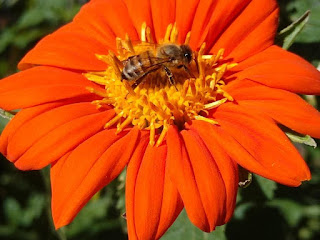
(Picture of Tithonia by Jeff Schalau)
Sharing is fun, especially when it comes from the garden. Of course I enjoy sharing produce with others, but my real love is in sharing flowers. It is an activity I can do with my wife that brings joy to our family, friends, and neighbors. I plant and raise the flowers, and my wife arranges them in mason jars to give away to whoever needs them. Maybe they just had a baby or just lost a loved one. Maybe they are sick or just had surgery. Or maybe they just need a pick-me-up or something to smile about. My wife and I were blessed to share our flower arrangements with 47 people last year.
I am always looking for new flowers to share. One flower I started using two years ago is Tithonia Rotundifolia of the Asteraceae family, commonly known as Mexican Sunflower. It has much the same open growth habit as of regular sunflowers. It grows over 6 feet tall and has vibrant orange/red, 3-to-4-inch flowers with a yellow center. They are beautiful in arrangements.

This year I hoped to still use Tithonia, but first I wanted to check out the allelopathic detriment Tithonia may have on other plants around it. The 2024 CCMG manual glossary defines allelopathy as: “The excretion by some plants’ leaves and roots of compounds that inhibit the growth of other plants.” 

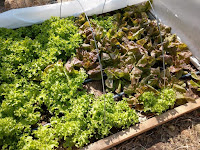
Jeff Schalau, an agent of agriculture for the University of Arizona, reported, “In my garden this year, the Mexican Sunflower (Tithonia rotundifolia) looks to have had serious allelopathic effects on my adjacent lettuce bed. The lettuce plants within four feet of the Tithonia are noticeably stunted.” 
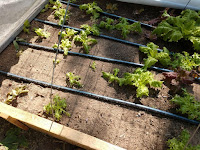

(Picture of the affected lettuce)
(Plot growing the same lettuce seed but isolated from Tithonia)

Good thing I don’t grow lettuce. Although Tithonia can have negative effects on other plants (Schalau also mentions legumes and cereals), it appears that it is only within close proximity. In my own garden, beans and tomatoes were planted about 10 feet away from the Tithonia but produced great, as did chard, peas, and peppers.


So of what benefit is Tithonia? As the North Carolina state extension Gardener Toolbox discusses, one of its ecological positives is its role as a pollinator. It is commonly used in gardens to attract butterflies, hummingbirds, songbirds, and other pollinators. I remember in my garden last year I had to pick them early each day before the plants were covered with bees. 


Now that I know Tithonia better as a great pollinator and understand the precautions needed to decrease allelopathic effects, I will invite this beautiful flower back into my yard. Who knows? Maybe my wife and I will share 50 arrangements this year.


Tuesday, June 5, 2018

Hollyhocks

It's easy to fall in love with the cheerful hollyhocks sprawled all over my elderly neighbor’s junk filled backyard. He was happy to share seeds with me and told me he remembered them from the 1950’s when his parents bought the farm.  

There are 1500 species and 27 genera in North America and grow in zones 2-10. The edible flowers are considered a delicacy in Turkey. Hollyhocks (Alcea rosea) are in the mallow family.

Hollyhocks require:
  • Full sun
  • Moist, well-drained soil
  • Should be watered with drip irrigation or soaker hose
  • Grow up to 8 feet tall
  • Biennials -- take two years from seed to bloom
  • Plants reseed themselves
  • Companion plants are pansies and campanulas
They attract hummingbirds and butterflies. In the Victorian era, hollyhocks were a symbol of ambition and initially were plants for the wealthy. They were used medicinally for respiratory ailments and for cooking.


My hollyhock plants looked ragged, with bumpy reddish growths on the lower leaves. The spots became dry, brown, and left holes in the lovely green leaves. Initially I treated them with a detergent based wash, then applied insecticide per the research from my plant books. The problem continued, and I noted that other gardens’ hollyhock leaves were equally as unattractive as mine. It seemed we would need to co-exist. I just picked off the offensive leaves.

Before Google was available for research I had to rely on books. In my master gardening class, I learned how to use the Google search site (site:.edu hollyhocks). Using this educational search, I was able to find out what was causing problems. To my amazement, the culprit was a fungus! The mystery was solved as I perused the pictures and found the Puccinia malvacearum fungus.

One of the most common problems with hollyhock is Rust (Puccinia malvacearum). Rust causes the plant to look ragged, with bumpy reddish growths on the lower leaves. The fungus overwinters in infected plant debris. In the spring new infectious spores are formed on infected plant debris that cause infection on the newly emerging leaves.

Disease Control Strategies: 

  • Cut infected plants at the soil line and remove debris as soon as the hollyhocks are done flowering. This prevents the rust disease from overwintering and infecting in the upcoming spring. 
  • In addition, remove and destroy any mallow weeds growing near hollyhocks.
  • Adding a layer of mulch around hollyhocks in the spring will hinder overwintering of spores within in plant debris. 
  • Scout hollyhocks in early spring. Remove and destroy the first leaves that appear infected. 
  • Proper location choice can be important to reduce the chance of infection. An ideal site will have adequate sunlight, good soil drainage, and sufficient air circulation.
  • It is also recommended to water the plants early in the day, so that they dry relatively quickly.
  • Consider purchasing more resistant varieties such as the Alcea rugosa and Alcea ficifolia.
  • A preventative fungicide can be applied to plants BEFORE infection or as soon as infection is detected. Frequent treatments will need to be applied as new growth emerges.
My initial plants are a very old variety, I have secluded a few and removed most of the plants. We have a large area, and I hope to avoid infecting any new plants. I have new plants from the seed swap at the Canyon County U of I Extension Office. According to Wisconsin Horticulture these are fungicide treatments and usage that will help your hollyhocks.  

“If you decide to use fungicides for control, select products that are labeled for use on hollyhocks (or more generally on ornamental flowering plants) and contain the active ingredients chlorothalonil, mancozeb, myclobutanil, tebuconazole, or triticonazole. When making more than one application, DO NOT use the same active ingredient for all treatments. Instead, alternate the use of at least two active ingredients with different modes of action to help minimize problems with fungicide-resistant variants of the hollyhock rust fungus. Myclobutanil, tebuconazole and triticonazole have similar modes of action and should NOT be alternated with one another. Be sure to read and follow all label instructions of the fungicides that you select to ensure that you use products in the safest and most effective manner possible.”

I will also be purchasing new seeds in my quest for lovely, cheerful hollyhocks!