Showing posts with label dahlias. Show all posts

Saturday, August 31, 2024

What do dahlias and corn have in common? Corn root beetle damage, that's what!

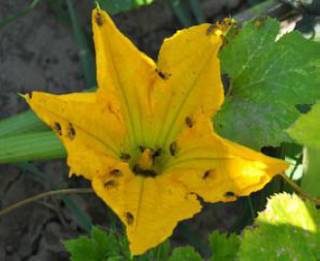
The corn root beetle is not confined to large agricultural crops; it can also invade home gardens and ornamental flowers. Fortunately, this pest has a limited life cycle, with only one generation per year. In the fall, female corn root beetles lay their eggs in the soil around corn plants. These eggs hatch the following spring, and the larvae begin feeding on the corn plant roots. By midsummer, the larvae pupate, and adult beetles emerge in search of pollen, primarily from corn silks, though they can also damage corn leaves. As the corn plants dry out later in the summer, the beetles seek other pollen sources, often targeting squash, cucumbers, pumpkins, and unfortunately, ornamental flowers such as dahlias, roses, and zinnias. They particularly favor lighter-colored blooms, causing extensive damage that can ruin the petals.
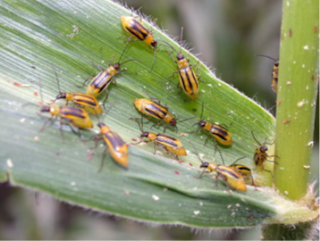
Effective management of corn root beetles involves integrated pest management strategies. Rotating corn crops annually, maintaining a distance of at least 10 feet from previous crop sites, helps break the beetle’s life cycle. Additionally, using biologics, managing weeds, and applying select soil pesticides can assist in controlling infestations. For agricultural producers, corn root beetles pose significant economic challenges, and for home gardeners, they can severely impact flower yields and health. With some planning and proactive mitigation efforts, it is possible to keep the corn root beetle populations in check


Last summer, in 2023, I undertook the task of growing the flowers for my daughter’s wedding, a project that initially seemed straightforward. I planted a variety of flowers—zinnias, dahlias, amaranth, hollyhocks, cosmos, celosia, and gomphrena—alongside corn to make the most of the garden space and to grow more vegetables. With limited experience and a constrained garden location, I didn’t realize the potential issues of planting corn so close to the wedding flowers.
At first, everything appeared to be going well. The corn germinated robustly, and the flowers started to sprout. I planted them later in the season to ensure ample blooms for the October wedding. While the dahlias were slow to start, by early August, both the corn and flowers were flourishing, with the dahlias beginning to grow in size.

However, by mid to late August, I noticed a concerning problem: the corn silks were disappearing, as if being shaved off. Upon closer inspection, I found that corn root beetles were to blame. These pests had not only damaged the corn silks but had also moved to the wedding flowers, particularly targeting the lighter-colored ones. The white and champagne dahlias suffered significant damage, as did the zinnias, hollyhocks, and amaranth.

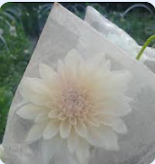
In a bid to save the flowers, I tried an insecticide, but it proved ineffective. Realizing I needed another approach, I covered the dahlias with organza bags—sheer fabric pouches designed to protect blooms from pests. These bags worked by physically blocking the beetles from reaching the flowers. Once the lighter-colored blooms were covered, the beetles shifted to other pollen sources, but the damage was already extensive.


Fortunately, my initial overplanting, due to my inexperience, ended up being beneficial. On October 14th, the weather was perfect, and my daughter’s wedding was a beautiful event. Despite the challenges with the beetles, the flowers looked lovely, thanks to the organza bags and the extra blooms from my overplanting. The day was a success, and seeing my daughter’s happiness made all the effort worthwhile.

Sunday, February 4, 2024

It's time to check your overwintering bulbs

If you are trying to overwinter bulbs (includes tubers, corms, and rhizomes) such as Dahlias, Tuberose, Amaryllis, Canna Lilies, Gladiolas - now is a great time to check them to see what condition they are in. Here are the main things to check:

#1 Check for Disease If bulbs are damaged in digging and not "cured" well while preparing them for storage, you can get a soft rot in them and it will spread from bulb to bulb, or tuber to tuber very fast. A fast way to check for this is to use your nose, the rot will give off a rather bad smell, once you detect the smell, then use your eyes to look for discolored material or material that is oozing and looks moist. Remove all bulbs that show the discolored symptom or are soft, you should also check with a master gardener to see is there is a fungicide that you can treat the ones not affected to protect them.
Canna lily rhizomes
Canna Lily
 #2 If you have put the bulbs in an organic bedding material, check it for moisture content - if it is damp that could increase problems with soft rot.

#3 Check the bulbs to see if they are wrinkling up which shows that they are drying out. Outside air can become very dry when it warms up causing a severe problem in over wintering your live material. 
Tubers such as dahlias are very prone to not surviving the winter unless they are in bedding material. If the bedding material is too dry,  it can allow the bulbs to dry out and die, of course if it is too damp then soft rot can be a problem. Newspaper works well for canna rhizomes as long as crinkled for good air space.
Gladiolus 
Gladiolus corms

#4 Check the temperature of the area you are storing them in. It should be less than 50 degrees F. and more than 40 degrees. It is very important that the bulbs do not freeze and if it gets too warm the bulb will start to grow and that can kill it. 
  
 Here's to beautiful blooms this coming year!

Sunday, February 7, 2021

How are your overwintering bulbs: Dahlias, Cannas, Gladiolas, and more...?

Dahlia
If you are trying to overwinter bulbs (includes tubers, corms, and rhizomes) such as Dahlias, Tuberose, Amaryllis, Canna Lilies, Gladiolas - now is a great time to check them to see what condition they are in. Here are the main things to check:

#1 Check for Disease If bulbs are damaged in digging and not "cured" well while preparing them for storage, you can get a soft rot in them and it will spread from bulb to bulb, or tuber to tuber very fast. A fast way to check for this is to use your nose, the rot will give off a rather bad smell, once you detect the smell, then use your eyes to look for discolored material or material that is oozing and looks moist.
Remove all bulbs that show the discolored symptom or are soft, you should also check with a master gardener to see is there is a fungicide that you can treat the ones not affected to protect them.

Canna lily rhizomes
Canna Lily
 #2 If you have put the bulbs in an organic bedding material, check it for moisture content - if it is damp that could increase problems with soft rot.

#3 Check the bulbs to see if they are wrinkling up which shows that they are drying out. Outside air can become very dry when it warms up causing a severe problem in over wintering your live material. 

Tubers such as dahlias are very prone to not surviving the winter unless they are in bedding material. If the bedding material is too dry,  it can allow the bulbs to dry out and die, of course if it is too damp then soft rot can be a problem.
Gladiolus corms

#4 Check the temperature of the area you are storing them in. It should be less than 50 degrees F. and more than 40 degrees. It is very important that the bulbs do not freeze and if it gets too warm the bulb will start to grow and that can kill it.

For more information on growing flowers, contact your local University of Idaho Extension office!

Friday, July 10, 2020

Does your tree look like this?

Damage is often patchy.
Have you ever noticed a tree with a branch that turns brown midway through the season while the rest look fine? Or a vegetable plant with stems turning yellow and brown?

What is it?  
Verticillium Wilt (Vw) V. dahliae  and Verticillium albo-atrum  is a soil borne disease that spreads through the roots to a plant’s vascular system. It can stump a gardener with early drought-like symptoms. It is a fatal disease of many important agricultural and horticultural crops. It is particularly present wherever potatoes and mint were farmed. And it can even kill a tree.

What does Verticillium Wilt look like? 
Vw symptoms can include wilt, chlorosis, reddish to purplish discoloration of leaves or stems and brown-stained or stunted leaves and vary widely between species.See video.
Vw on Maple

If you think your plant is infected, first find out whether that species is a host. Plants Resistant Or Susceptible To Verticillium Wilt, developed by the University of California, is a good resource
Proper diagnosis requires laboratory testing to rule out other organisms. Homeowners can submit a sample of soil to find out the level of Vw in the soil. The cost is $50.00 for plant material sample and $105.00 for the soil testing at the University of Idaho Plant Disease Diagnostics Lab in Parma, Idaho. Be sure to contact the lab first for specific instructions at (208) 722-6701.

What Types of Plants are susceptible?
Vw affects over 300 species. Trees most commonly and severely affected are maple and ash. The list also includes red-bud, lilac, catalpa, and smoke-bush.
Vw on dahlia
Vw on blackberry
Annuals, including dahlia and sunflower can be infected, as well as garden plants like cantaloupe, tomato, and asparagus. Once affected, roots may not develop normally again.
Dr. James Woodhall, Assistant Professor and Plant Pathologist with the U of I Parma Research Center says Vw is patchy – particularly in maples, but also as it appears throughout your property. Not every inch of ground will have it.

How do I save a tree or shrub with Verticillium wilt?  
Trees and shrubs infected with this systemic disease cannot be cured. They may die quickly in one season or slowly over several years. However, you can extend the life of your plants by making sure that you water and fertilize properly. 
In woody host plants, pruning of symptomatic limbs to remove all discolored sapwood, followed by burning, has prolonged the life expectancy of some trees.

If you remove a plant or tree because of this, be sure to plant a high value tree in some other field. This fungal genus may remain alive in the soil for many years in a resting state.

Can I Prevent Verticillium damage in the future?
The best way to avoid Vw is to plant deciduous trees and shrubs that are immune or resistant. You may have seen some or all of the letters VFNT next to the names of hybrid plant varieties in catalogs and on seed packets. The name will have a V following the variety name if it is resistant to Vw. Always test the soil before planting, especially with high value trees. Purchase disease tolerant trees and plants.

Brian Hudelson, UW-Madison Plant Pathology advises not to use mulches that may have been produced from infected trees or have unknown composition. Finally, immediately collect and discard leaves that have fallen from symptomatic trees.  Both mulch and leaves are potential sources of Verticillium.