Showing posts with label core aeration. Show all posts

Thursday, March 23, 2023

Early Spring Lawn Care

Spring is here! The days are getting warmer and longer. We look out at our lawn coming out of a long winter that has not been fed for a while. Its color is off and we think: if I hit it with lots of water, dump some fertilizer on it that will fix it. But wait… there are a few things to consider about feeding and watering your lawn before you start.

C:\Users\jbbow\AppData\Local\Microsoft\Windows\INetCache\Content.MSO\A278CA17.tmpWhen to Fertilize
A program that applies fertilizer four times a year, using the holidays of Easter, Memorial Day, Halloween and Thanksgiving as a guide is desirable. An application of a quick release formula, where the nitrogen is quickly available to the plants, is best in the spring and slow release formulas, where the release of nitrogen is slower can be used for the rest of the applications.  It is better if the late fall application is slow release so the nutrients are released into the soil during the winter to help with lawn recovery in the spring.
Image result for lawn fertilizerWhat Type of Fertilizer
The ratio of nutrients on any plant food is represented by Nitrogen- Phosphorus- Potassium (N-P-K) in numbers. The numbers state the amount of each. For instance, a 10-10-10 is a balanced food with equal parts nitrogen, phosphorus and potassium. A fourth number would represent Sulfur (S).
Nitrogen promotes foliar growth and color. Phosphorus is useful in encouraging flower and root growth. Potassium in lawns enhances the plant’s ability to use nitrogen.
Lawns in southern Idaho can be fertilized by following one of two strategies: soil testing or nutrient ratios. In one, fertilizer rates for the lawn are based on a laboratory analysis of a soil sample. The other is based on the fact that lawns do best when fertilized with a fertilizer having a 3:1:2: ratio of N, P, K.  Spring applications can use a ratio where the phosphorus ratio is higher to promote root growth.                                 
Watering
Water deeply and less often to promote deep roots. Apply between 1”-1 1/2” of water weekly, depending on weather conditions, soil type, and landscape terrain (slopes, etc.). Soil should be moistened to a depth of about six inches. To test sprinkler output, place empty tuna fish cans or cat food tins along the water arc to see how long it takes your sprinkler to put down this amount of water. Output is greater the farthest point from the sprinkler head. (You can allow the cans to fill 1/4” or 1/2” and multiple accordingly.) One application a week may be all that is necessary, or you can divide the time into two or three applications per week. Also, take into consideration the areas where sprinklers overlap an area, and that sprinkler output varies. During hot weather, increase the water to 2” per week and apply more frequently if necessary. Visual clues that the lawn needs watering are when the grass begins to take on a blue-green color or has lost its spring, leaving an imprint behind when walked upon.
Aeration
Core aeration opens up avenues for water and fertilizer to reach down to the root zone, thus stimulating the activity of soil microorganisms and increasing root development. Lawns that have not been aerated before or those that get heavy foot traffic may benefit by aerating twice per year, once in the spring and again in the fall for the first two or three years, then drop back to once per year. On lawns that are regularly core aerated once per year in the spring is enough. Do not rake up plugs afterwards, these are topsoil and will decompose naturally, mow over them and they will soon disappear. An application of no more than a ¼” of compost after spring aeration is beneficial for all lawns.
Thatch
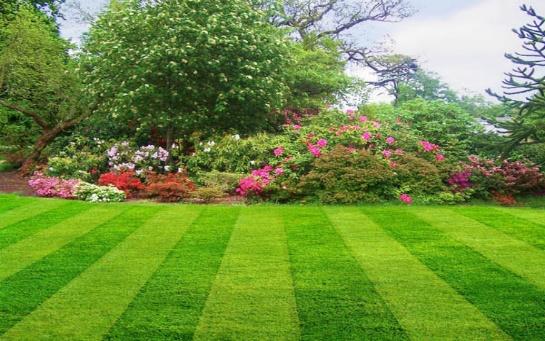
Image result for lawnThatch is not caused by leaving grass clippings on the lawn, as is commonly believed. It is an accumulation of dead and partly decomposed leaves, stems and roots above the soil surface but below the green leaves. Up to 1/2 inch of thatch is beneficial, acting as natural mulch, insulating the soil, reducing water evaporation and soil compaction, and increasing the lawns spring and wear tolerance.
Too much thatch serves as a barrier preventing air and moisture from moving into the root zone of the plants, causing the turf to dry out much too rapidly. This provides a haven for insects and disease. If thatch is over 1/2 inch, power raking in early spring is advised. Power raking every year is not necessary and may actually damage the lawn.
Giving your lawn an application of a slow release fertilizer in the fall will give your lawn a jump-start in the spring.

Saturday, April 20, 2019

Steps to a Healthy Lawn and controlling Weeds

The first step to having a healthy and attractive lawn and controlling weeds is choosing a grass variety best adapted to your life style and available resources. Factors to consider would be high traffic, shaded and sunny areas, type of soil, available water and amount of time available to care for the lawn.

Irrigate properly to help reduce annual weed infestation. Light frequent irrigation encourages weed seed germination, even if a pre-emergence herbicide has been applied. Water 1- 1.5 inches per watering. Do not water again until you see signs of wilt. Turf will also turn a shade of blue green when it is water stressed. The best time to irrigate your lawn is between 10 pm and 6 am.

Mowing The preferred mowing height for all species of grass is 2 ½ - 3 inches. The minimum height that any lawn should be mowed is 2 inches. Mowing to heights less than 2 inches results in decreased drought and heat tolerance plus higher incidences of insect, disease, and weed problems. The seeds of some weeds require high light intensity to germinate. The shaded environment near the soil surface in high mown lawn helps deter weed germination. Mow frequent enough that no more than one third of the grass height is removed at any single mowing. If the mowing height is two inches. the grass should be mowed when it is 3 inches tall. If the mowing height is 3 inches, it should be mowed when it's about 4 inches. Keep your mower blade sharp to avoid shredding and fraying leaf blades. Grass clippings should be allowed to fall back into the yard to provide natural nitrogen.

Pre-emergence herbicides. A Pre-emergent is activated in the top layer of soil, where the weed seeds sprout, and by design it stops the plant from growing. A pre-emergent is NOT effective once the weeds are showing. Spreading out the herbicide so that it is evenly distributed is critical. It must also be watered into the soil within the appointed time period. The soil must remain undisturbed in order to maintain the barrier. A pre-emergent has to be replaced, or replenished. Pre-emergence should be applied two to four weeks before when seeds germinate in mid March to early April depending on weather. Warm moist springs cause earlier germination The temperature of the soil ( 55-60 degrees) as it starts to warm up in the spring, will be the primary indicator of the pending arrival of various weed species. With normal weather patterns, pre-emergence herbicides give good to excellent control of crabgrass, foxtail, and barnyard grass. Do not over seed into areas that have recently been treated with pre- emergence.

Post- emergence herbicides. Perennial broadleaf weeds can be controlled by post emergent herbicides. It is important to properly identify the weed before choosing an herbicide. Some common perennial broadleaf weeds in lawns are dandelion, field bindweed ( morning glory) White clover, curly dock, ground ivy, Canada thistle, broad leaf plantain, buckhorn plantain and yarrow. The best time to control perennial weeds is in late summer or early fall when weeds are preparing for winter.

Core cultivate (aerate) the lawn at least once a year to reduce compaction and to control thatch.
Fertilizer may be needed if lawn has poor color and vigor, doesn’t recover from traffic or has more weeds present. Nitrogen is the most important nutrient for lawns. Do not use Phosphorus or Potassium unless a soil test indicates it is needed. Cool season grasses should be fertilized in fall, late spring and little in the summer. Warm season grasses should be fertilized late May, June, avoid late summer and fall.

Check out the resources below:

Thursday, April 11, 2019

Your Lawn Needs Care Now!

Image result for early spring lawn
Spring is here! The days are getting warmer and longer. We look out at our lawn coming out of a long winter that has not been fed for a while. Its color is off and we think: if I hit it with lots of water, dump some fertilizer on it that will fix it. But wait… there are a few things to consider about feeding and watering your lawn before you start.

When to Fertilize
C:\Users\jbbow\AppData\Local\Microsoft\Windows\INetCache\Content.MSO\A278CA17.tmpA program that applies fertilizer four times a year, using the holidays of Easter, Memorial Day, Halloween and Thanksgiving as a guide is desirable.
An application of a quick release formula, where the nitrogen is quickly available to the plants, is best in the spring and slow release formulas, where the release of nitrogen is slower can be used for the rest of the applications.  It is better if the late fall application is slow release so the nutrients are released into the soil during the winter to help with lawn recovery in the spring.

What Type of Fertilizer
Image result for lawn fertilizerThe ratio of nutrients on any plant food is represented by Nitrogen- Phosphorus- Potassium (N-P-K) in numbers. The numbers state the amount of each. For instance, a 10-10-10 is a balanced food with equal parts nitrogen, phosphorus and potassium. A fourth number would represent Sulfur (S).
Nitrogen promotes foliar growth and color. Phosphorus is useful in encouraging flower and root growth. Potassium in lawns enhances the plant’s ability to use nitrogen.
Lawns in southern Idaho can be fertilized by following one of two strategies: soil testing or nutrient ratios. In one, fertilizer rates for the lawn are based on a laboratory analysis of a soil sample. The other is based on the fact that lawns do best when fertilized with a fertilizer having a 3:1:2: ratio of N, P, K.  Spring applications can use a ratio where the phosphorus ratio is higher to promote root growth.                                 
Watering
Water deeply and less often to promote deep roots. Apply between 1”-1 1/2” of water weekly, depending on weather conditions, soil type, and landscape terrain (slopes, etc.). Soil should be moistened to a depth of about six inches. To test sprinkler output, place empty tuna fish cans or cat food tins along the water arc to see how long it takes your sprinkler to put down this amount of water. Output is greater the farthest point from the sprinkler head. (You can allow the cans to fill 1/4” or 1/2” and multiple accordingly.) One application a week may be all that is necessary, or you can divide the time into two or three applications per week. Also, take into consideration the areas where sprinklers overlap an area, and that sprinkler output varies. During hot weather, increase the water to 2” per week and apply more frequently if necessary. Visual clues that the lawn needs watering are when the grass begins to take on a blue-green color or has lost its spring, leaving an imprint behind when walked upon.

Aeration
Core aeration opens up avenues for water and fertilizer to reach down to the root zone, thus stimulating the activity of soil microorganisms and increasing root development. Lawns that have not been aerated before or those that get heavy foot traffic may benefit by aerating twice per year, once in the spring and again in the fall for the first two or three years, then drop back to once per year. On lawns that are regularly core aerated once per year in the spring is enough. Do not rake up plugs afterwards, these are topsoil and will decompose naturally, mow over them and they will soon disappear. An application of no more than a ¼” of compost after spring aeration is beneficial for all lawns.
Thatch
Thatch is not caused by leaving grass clippings on the lawn, as is commonly believed. It is an accumulation of dead and partly decomposed leaves, stems and roots above the soil surface but below the green leaves. Up to 1/2 inch of thatch is beneficial, acting as natural mulch, insulating the soil, reducing water evaporation and soil compaction, and increasing the lawns spring and wear tolerance.
Image result for lawnToo much thatch serves as a barrier preventing air and moisture from moving into the root zone of the plants, causing the turf to dry out much too rapidly. This provides a haven for insects and disease. If thatch is over 1/2 inch, power raking in early spring is advised. Power raking every year is not necessary and may actually damage the lawn.
Giving your lawn an application of a slow release fertilizer in the fall will give your lawn a jump-start in the spring.

Tuesday, April 17, 2018

The Homeowner: The First and Last Line of Defense on Quality.

When it comes to shopping, my friends all know it takes me a long time to make a decision. I methodically research out what I want. Then I narrow it down to a few items. After I look over my choices carefully, I may go home to get on the internet and look at consumer reviews; I may go from store to store and check out prices. I look for quality and I look to make sure I am getting a product that is worth the money I am spending on it. I want to make sure my investment will last. Sometimes, my shopping experience will last hours, days, or in the case of a car or computer, it could be months.

My yard is no different. When I need yard work done, such as lawn aeration or tree trimming, I am insistent on high quality work. As a homeowner you are the first and the last line of defense when it comes to making sure that a quality job is done, and done correctly! Knowing what to expect in landscape maintenance and being armed with a small amount of knowledge as a consumer can play in your favor.

Always hire a certified professional to do your work. Would you seek medical advice from an individual who was not licensed to practice medicine? Of course not! Why then would you do it with your yard? I recommend that you check into the individual or company before hiring them. Do some homework. How have they been trained? Where is their certification from? Are they insured, licensed, and can they provide you documentation? Are they registered with the Better Business Bureau? If so, what is their rating? Drive around and check on some of their previous work. Is it the kind of quality you would want in your own yard? Ask for references. Ask questions! This is, after all, a job interview for the contractor. Just because they are the cheapest does not mean they should get the job, and just because they slap a business magnet on the side of their pick-up truck does not mean they know what they are doing!  In the following I will be talking with you about what to look for when hiring a contractor to do yard work and how certain procedures should be done. Armed with this knowledge, you will be better able to ensure the work done in your yard is of the quality you deserve for the money you pay.

Core aeration with plugs on 2 inch centers is one of the best things you can do for your lawn!Lawn Aeration is perhaps one of the best things that you can do for your lawn. Done twice a year, once in the spring and once in the fall, core aeration combats soil compaction. Soil compaction is a problem in nearly 80% of all landscapes. In addition, aerating your lawn helps combat thatch accumulation and reduces the amount of water you need to apply to your lawn. The reason for this is because when your soil is compacted oxygen and water can’t penetrate into the soil. Fertilizer can’t get penetrate the soil either. As a result, roots are often shallow, and the lawn will need more frequent irrigation. (1, 2, 3, 4)  
Core aeration removes small plugs, about 1-3 inches long from the soil. A single aeration using a machine with 1/2-inch diameter tines removes as much as 10 percent of the thatch if enough passes are made to achieve average 2-inch spacing between holes. Remember the key is 2-inch spacing. This may mean that multiple passes on the lawn are required. This small investment of an extra $10 will pay dividends in the end.   

What you do with the cores is your choice. Just remember, 2 inch centers!
What do you do with the cores after you have had the lawn aerated? That really is a personal decision. Some people do not like the little plugs being left on their lawn, although there may be benefits to allowing them to disintegrate into the lawn again.

If you do decide to remove them, they are great for the compost bin. Other options may be to power rake the lawn after aeration, watering, or simply running a lawn mower over the lawn after you aerate (although this practice will cause the blades on your lawn mower to dull). Once you have aerated your lawn if you need to reseed, this is the optimum time to do it. The best part of reseeding now is there is no need to top dress the lawn, as the lawn seeds will have nice little holes in which to germinate!

Another type of aeration being marketed by many lawn care companies these days as a replacement for core aeration is liquid aeration. While different ingredients make up this popular lawn service, the main ingredients seem to be liquid humates (organic matter) and sodium lauryl sulfate (soap). These are nothing more than snake oil remedies and are no substitution for the real deal of removing the plugs from your lawn by core aerating. There is no scientific research which has shown chemical aeration to be effective. You may as well throw dirty dish water out on your lawn. (5) (Cultural and Chemical Controls of Thatch and Their Influence on Rootzone Nutrients in a Bentgrass Green
Lloyd M. Callahan, William L. Sanders, John M. Parham, Cynthia A. Harper, Lori D. Lester and Ellen R. McDonald
Crop Science  
1998 38: 1: 181-187
doi:10.2135/cropsci1998.0011183X003800010030x)
The thing to remember from all of this is that you want to have your lawn aerated twice a year; in the spring, and again in the fall. The plugs removed should be 2-3 inches long, and on 2 inch centers, which may require multiple passes on your lawn. If you have further questions, please call your local University of Idaho Extension Office

TreePruning is something I take seriously. It is a science which should not be left to a novice and is far more than could be covered in one article. For me, spotting a bad tree pruning job is as easy as spotting a bad haircut. The only difference is a bad hair cut grows back and has no adverse side effects on your health. However, a pruning job can have enormous effects on the health of a tree, either for good, or for bad. When you hire an arborist, make sure they are ISA certified, licensed, and insured. To find an ISA certified arborist, visit http://preview.tinyurl.com/d44d9rp

The key points for a good pruning job really come back to structurally pruning the tree correctly when the tree is young. Improper or lack of pruning when the tree is young can greatly increase the likelihood of tree failure when the tree is older. Cuts on branches larger than 4 inches increase the possibility of decay and disease. If possible, prune trees when the branches are smaller than 4 inches in diameter.

When pruning a tree, prune the branch all the way back to the branch collar, or about 1/4 inch from the trunk.
When pruning trees, it is important to prune the branch back to the branch collar. Don’t leave stubs, or what I call “hangars” where you can hang your coat. Leaving these nubs will cause decay and disease to move into your tree. 

The last key component to pruning is to always remove a smaller branch back to the parent branch, never the other way around. When you remove a parent branch, unless the wood is dead, you greatly increase the risk of beginning the downward spiral of death and decay in the tree. While this is great for your tree-trimming company who will have to come back year after year to remove an ever increasing amount of dead wood from the canopy of the tree, it is hard on your pocketbook; more importantly, your tree's life is shortened! By knowing some pruning basics, you can ensure that you are hiring a professional who knows what they are doing, and will extend the value and life of your landscape. 
For more information, contact your local University of Idaho Extension Office. Our Master Gardeners Turf/Tree Team will be glad to assist you.


1. Carrow, R. N., B. J. Johnson, and R. E. Bums. 1987. Thatch and quality of Tifway bermudagrass turf in relation to fertility and cultivation. Agronomy Journal, 79: 524-530. 

2.  Dunn, J. H., D. D. Minner, B. F. Fresenburh, S. S. Bughrara, and C. H. Hohnstrater. 1995. Influence of core aerification, topdressing, and nitrogen on mat, roots, and quality of "Meyer" zoysiagrass. Agronomy Journal, 87: 891-894.

3.  Erusha, K. S., R. C. Shearman, and D. M. Bishop. 1989. Thatch prevention and control. Turfgrass Bulletin, 10(2): 10-11(Carrow et a1., 1987; Erusha et a1., 1989; Dunn et a1., 1995; Lederboer and Skogley, 1967; Shildrick, 1985; White and Dickens, 1984)

4.  Murray, J.J., & Juska, F.V. (1977). Effect of management practices on thatch accumulation, turf quality, and leaf spot damage in common Kentucky bluegrass [Poa pratensis]. Agronomy Journal, (3), 365-369.

5. Lloyd M. Callahan, William L. Sanders, John M. Parham, Cynthia A. Harper, Lori D. Lester and Ellen R. McDonald. Cultural and Chemical Controls of Thatch and Their Influence on Rootzone Nutrients in a Bentgrass Green. Crop Science, 1998 38: 1: 181-187
doi:10.2135/cropsci1998.0011183X003800010030x