Showing posts with label JGH. Show all posts

Saturday, May 10, 2025

With Thrill, Fill, Spill - Container Gardening May Be your Answer!

Container Gardening Guide, Elisabeth C. Miller LibraryWant to add color to your landscape without fighting Idaho’s heavy clay soil?

Container gardening may be the answer! More than just for areas with limited space, containers are great for adding height in an existing garden, as a way to plant areas with difficult in-ground soil conditions, or as a portable home for plants that cannot survive the winter months outdoors. They also allow gardeners an opportunity to experiment with combinations of colors and textures on a small scale before taking on a bigger planting.

Additionally, I use container gardens within my own landscape in order to create visual levels of plantings within my border, as well as an alternative to battling digging out and amending the hard clay soil.


Key considerations when gardening in containers: 

  1. Location: When determining where to place your containers, it is important to consider the amount of sunlight the location gets during the day. 

  2. Container Gardening, Too! Webinar | Cooperative Extension | The University  of ArizonaContainer: Containers should have adequate drainage and not be too much larger in size (around) than the combined area needed for the plants that will be planted in the container.

  3. Soil: The soil should be mostly a potting soil mix, that can be amended with organic material (compost, peat moss). When adding material to the potting soil, the soil and organic material should be well combined in order to have a uniform texture and allow for proper drainage. 

  4. Plant selection: Based on the amount of sun that the container will get during the day, select plants that have similar amounts of sunlight and water required. 

  5. For plant recommendations and ideas, check out this article from Oregon State University.

How to Design a Container Garden:

Designing a container garden lets the gardener be free to create playful and eye-catching garden spaces. 

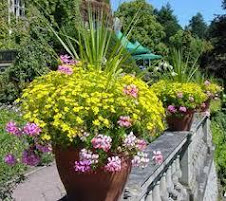
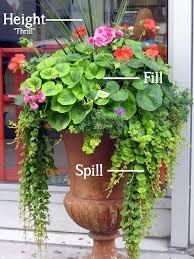
The primary design elements of a container garden are the thrill, fill, and spill

  1. The thrill is usually a planting that creates height in the container, it is a planting that is often centered in the container and is taller than the rest. 

  2. The fill is a plant or plants that are similar in height, but shorter than the thrill. The fill occupies the middle section of the container planting and may have pops of color contrast that draw the eye toward the container. 

  3. The spill is typically a trailing plant that spills over the side of the container and adds both drama and texture.   

Trying to decide which is right for you - container gardening or raised beds? Check out these five tips.

Friday, December 8, 2023

Fun Indoor Plants for the Holidays and Beyond

Cooler temperatures mark the end of the gardening season for many, but for people who love plants, winter is just an excuse to move our favorite hobby indoors. Your home can become a showcase of what can be grown indoors, and holiday seasonal plants can be a fun place to start. Let’s talk about some of the best holiday plants that can be enjoyed year-round if cared for properly.

One of my favorite indoor plants is the Norfolk Island pine, sometimes called the Star Pine. Araucaria heterophylla. This beautiful, coniferous tree grows slowly indoors and needs plenty of light. It may start as a tabletop Christmas Tree but, if correctly cared for over the years, this plant will grow into a small tree. It does best in a bright window and thrives with average water and humidity.

The most common winter Holiday plant, the Euphorbia pulcherrima, or Poinsettia, is a classic and is sold in various sizes in December. Care for your plant and it will reward you year after year. The bracts are what change color to form the traditional Christmas plant. Colors range from burgundy, purple, white, red, and pink with variations of solids, mottling, and variegation. 

This Poinsettia is native to Mexico and the legend of the plant goes something like this:
There was once a poor Mexican girl called Pepita who had no present to give the baby Jesus at the Christmas Eve Services. As Pepita walked sadly to the chapel her cousin Pedro tried to cheer her up. 'Pepita', he said, "I'm sure that even the smallest gift, given by someone who loves him, will make Jesus happy." Pepita didn't know what she could give, so she picked a small handful of weeds from the roadside and made them into a small bouquet. She felt embarrassed because she could only give this small present to Jesus. As she walked through the chapel to the altar, she remembered what Pedro had said. She began to feel better, knelt, and put the bouquet at the bottom of the nativity scene. Suddenly, the bouquet of weeds burst into bright red flowers, and everyone who saw them was sure they had seen a miracle. From that day on, the bright red flowers were known as the 'Flores de Noche Buena', or 'Flowers of the Holy Night'. The shape of the poinsettia flower and leaves are sometimes thought of as a symbol of the Star of Bethlehem which led the Wise Men to Jesus. The red-colored leaves symbolize the blood of Christ. The white leaves represent his purity.

Rosmarinus officinalis, commonly referred to as Rosemary, grows well as a Christmas-tree-shaped house plant and makes a nice tabletop or kitchen plant. Some people love the smell of Rosemary and having a fresh sprig to use for your holiday recipes is a bonus. Although not as vigorous as a Norfolk Island pine, it can be planted outside in the spring. This plant just needs a little water, and a happy window to look out if grown indoors.

A more traditional plant to grow indoors is the Schlumbergera spp, or Christmas cactus. With flowers that range from orange to pink to red and even purple, these plants do not require a lot of water, and are a good choice for plant owners who travel a lot. Here are some tips that will help initiate flowers in Christmas cactus.

Narcissus papyraceus or Paperwhites are closely related to Daffodils and are grown indoors. They are fragrant and easy to grow. Just pot them and place them in a window away from drafts and enjoy! A fun craft idea for kids is to buy a simple pot from any craft store and have them decorate and plant it for the holidays.

Another one of my favorites, which happens to be a bulb, is the Amaryllis. From the genus Hippeastrum, these bulbs are also native to South America. What I love about these bulbs is that they are so ridiculously easy to grow. Grab a shallow glass vase or pot, fill it with gravel, stick the bulb on top, give it some water, and watch it start growing. It takes about 6 weeks for it to bloom once it is planted. The colors are deep red to white with all types of variations in between. Because they can tolerate a lot of abuse, Amaryllis are a great indoor plant for college kids and people who have pets.

A relatively new one to the scene is Cupressus macrocarpa, or Lemon Cypress. This dwarf shrub, with chartreuse green foliage, can be grown in a pot and is a wonderful bright addition to your home. Potted cypresses need sunlight and are used to bright, sunny locations outdoors. Their soil should be kept moist but not wet and should not be allowed to dry out. A good test is to insert your finger into the pot down to the first knuckle and then remove it. If soil particles adhere to your fingertip, the plant does not need water at that time. Lemon Cypress can go outdoors and live as a containerized plant or be planted in the ground in USDA zones 7 to 10. 

So, while gardening outdoors may have been placed on pause for the winter, above are several plants that I hope will inspire you to keep growing through the Holiday Season and long afterward.

Thursday, February 16, 2023

Spring Greenhouse Prep

How did you close down your greenhouse last fall? Perhaps you are like most gardeners and left it in a bit of disarray from the scramble of fall garden cleanup that we all experience. It's okay, we have a few tips to help you get your greenhouse ready for spring!

First, we recommend removing everything from your greenhouse (overwintered plants, removable shelving, pots, trays, tools, floor mats, etc.) These items will be sanitized in another area. Do this in an open area with a breeze and sunshine, if possible.
  1. Start at the top of the greenhouse 
    Starting at the back and at the top of your greenhouse, working your way down and forward, will ensure you get every area in the greenhouse cleaned. Don’t forget to use a variety of brushes to clean the nooks and crannies where the panels connect to the frame, hinges on windows and doors, around vents, etc. Sweep the walls, clean the floor (soil or concrete) of all organic matter and weeds. 

  2. Flooring
    Floors, which can be made of many substrates, must be cleaned accordingly. There are concrete floors that can be scrubbed with a bleach solution. If the floor is dirt or rock, there will be weed maintenance as well as pest and pathogen procedures for the spring cleaning. Pull and discard any weeds that have sprung up to keep the potential pests and pathogens at bay. Whatever weed barrier you choose should be removed and replaced annually as well.

  3. Select cleaning agents and equipment 
    There are many choices when selecting cleaning equipment and agents: pressure washers with soap and water, Strip-it, etc. Be sure to read labels, talk to your garden center expert or a greenhouse supplier to help you decide. Rubbing alcohol can be used on knives and pruners. Although it is not recommended for the structure itself, household chlorine bleach is probably the least expensive and the easiest to obtain for a general disinfectant. Its half life is short; therefore, it should be mixed fresh, and items should be soaked for 30 minutes to be a thorough sanitizing. It Is used in a solution of 1 part bleach to 9 parts water. 

  4. Allow time to dry
    All items, including the structure, should be allowed to dry out completely by opening windows and leaving on fans before re-furnishing the greenhouse.

It is important that we keep our greenhouses clean to avoid pitfalls during the growing season.  

Have an amazing growing season!

Thursday, January 26, 2023

Winter Houseplant care with new lighting info

Caring for houseplants during the winter months is vital to maintaining these beauties at their best! Winter conditions indoors require homeowners to change the way they manage the humidity (or lack of), watering, and placement of houseplants. Plants require the correct amount of light and water in order to live, which will vary greatly, depending on the type of plant you have.

Light can be measured in two simple ways: Quality is the color and brightness of the light, while quantity refers to the number of hours a plant receives light. There are a few options for light sources, but light-emitting diodes (LEDs) are both energy-efficient and last a long time. Additionally, LED plant lights emit only the red and blue light needed by plants, with little heat.

Light quality and quantity are important for houseplants as they impact color, size, shape, and flowering. A light meter can be purchased at your local garden center to tell you how much light your plant is receiving. 
How frequently you need to water your plant depends on several things [video]:
  • The type of medium in which your plant is growing.  Soil moisture probes are instruments that measure soil moisture. There are even some that send you a text message telling you that you need to water your plant. 
Here are some great tips for how to care for your sick plant.  Houseplants, just like other plants, often get sick due to under- or over-watering, over fertilizing, or lack of attention.

Enjoy the benefits of your houseplants all year long!

Sunday, January 9, 2022

Especially in winter...Houseplants: Right light, right water!

Caring for houseplants during the winter months is vital to maintaining these beauties at their best! Winter conditions indoors require homeowners to change the way they manage the humidity (or lack of), watering, and placement of houseplants. Plants require the correct amount of light and water in order to live, which will vary greatly, depending on the type of plant you have.


Light can be measured in two simple ways: Quality is the color and brightness of the light, while quantity refers to the number of hours a plant receives light. 

Light quality and quantity are important for houseplants as they impact color, size, shape, and flowering. A light meter can be purchased at your local garden center to tell you how much light your plant is receiving.


How frequently you need to water your plant depends on several things [video]:
  • The type of medium in which your plant is growing.  Soil moisture probes are instruments that measure soil moisture. There are even some that send you a text message telling you that you need to water your plant. 
Here are some great tips for how to care for your sick plant.  Houseplants, just like other plants, often get sick due to under- or over-watering, over fertilizing, or lack of attention.

Enjoy the benefits of your houseplants all year long!

Saturday, December 4, 2021

So-o-o many choices for growing Indoors for the Holidays

For some, cooler temperatures mark the end of the gardening season, but for those of us who love plants, we know that we just change the locale of where we work. In the spring and summer, we work outdoors; in the fall and winter, we move indoors. My home has become an indoor showcase of what can be grown indoors in the winter. Holiday decorations can be augmented with living plants of various types.

One of my favorites includes the Norfolk Island pine, sometimes called the Star Pine. Araucaria heterophylla is a beautiful, coniferous tree that grows slowly indoors and needs plenty of light. You may receive this as a table top Christmas tree and, if correctly cared for, over the years, this plant will grow into a small tree. It does best in a bright window, and thrives with average water and humidity.
The most common winter holiday plant, the Euphorbia pulcherrima, or Poinsettia, will, contrary to popular belief, not make you sick if you eat it, although I am unsure why you would want to. Care for your plant and it will reward you year after year. The bracts are what change color to form the traditional Christmas plant. Colors range from burgundy, purple, white, red, and pink with variations of solids, mottling, and variegation. Native to Mexico, the legend of the plant goes something like this:
There was once a poor Mexican girl called Pepita who had no present to give the baby Jesus at the Christmas Eve Services. As Pepita walked sadly to the chapel her cousin Pedro tried to cheer her up. 'Pepita', he said, "I'm sure that even the smallest gift, given by someone who loves him, will make Jesus happy."  Pepita didn't know what she could give, so she picked a small handful of weeds from the roadside and made them into a small bouquet. She felt embarrassed because she could only give this small present to Jesus. As she walked through the chapel to the altar, she remembered what Pedro had said. She began to feel better, knelt down and put the bouquet at the bottom of the nativity scene. Suddenly, the bouquet of weeds burst into bright red flowers, and everyone who saw them were sure they had seen a miracle. From that day on, the bright red flowers were known as the 'Flores de Noche Buena', or 'Flowers of the Holy Night'.  The shape of the poinsettia flower and leaves are sometimes thought as a symbol of the Star of Bethlehem which led the Wise Men to Jesus. The red colored leaves symbolize the blood of Christ. The white leaves represent his purity.

Rosmarinus officinalis, commonly referred to as Rosemary, grows well as a Christmas-tree-shaped house plant and makes a nice table top or kitchen plant. Some people love the smell of Rosemary and having a fresh sprig to use for your holiday recipes is an added bonus. Although not as vigorous as a Norfolk Island pine, it can be planted outside in the spring. This plant just needs a little water, and a happy window to look out if grown indoors.

Another more traditional plant to grow indoors is the Schlumbergera spp, or Christmas cactus. With flowers that range from orange to pink to red and even purple, these plants do not require a lot of water, and can handle me forgetting to tend to them if I am out of town for the holidays. Here are some tips that will help initiate flowers in Christmas cactus.
Narcissus papyraceus or Paperwhites are closely related to Daffodils, and are grown indoors. They are fragrant, and easy to grow. Just pot them up and place them in a window away from drafts and enjoy! A pot from any craft store can easily be decorated for the holidays and used to brighten up any room, which also makes it a great craft idea and can be a fun project to do with children!
Another one of my favorites, which happens to be a bulb, is the Amaryllis. From the genus Hippeastrum, these bulbs are also native to South America. What I love about these bulbs is that they are so ridiculously easy to grow. Grab a shallow glass vase or pot, fill it with gravel, stick the bulb on top, give it some water, and watch it start growing. It takes about 6 weeks for it to bloom once it is planted. The colors are deep red, to white with all types of variations in-between. They tolerate abuse from animals, too. I had an Amaryllis named Jar-jar in my apartment in college with 5 other roommates and it did quite well.
https://www.mygardeninsider.com/the-gardeners-library/3671/cupressus/macrocarpa/goldcrest
A relatively new one to the scene is Cupressus macrocarpa, or Lemon Cypress. This dwarf shrub, with chartreuse green foliage, can be grown in a pot and is a wonderful bright addition to your home. 
Potted cypresses need sunlight and are used to bright, sunny locations outdoors. Their soil should be kept moist but not wet and should not be allowed to thoroughly dry. A good test is to insert your finger into the pot down to the first knuckle and then remove it. If soil particles adhere to your fingertip, the plant does not need water at that time. Lemon cypress can go outdoors and live as a containerized plant or be planted in the ground in USDA zones 7 to 10.
So, while the gardening outdoors may have been placed on pause for the winter, above are several plants that I hope will inspire you to keep growing through the holiday season and long afterwards.

Sunday, July 25, 2021

Victory Gardens for the 21st Century

During the difficult days of World War II, Americans rallied to support the nation’s war effort. One of the many ways they were encouraged to help out was to plant and utilize produce grown from their own efforts.  While it was a way to increase food production, it also enabled people to save money and to become more self-sufficient.  Additionally, it improved and increased the American diet with nutritious foods picked at their peak.

It is out of this effort, that the notion of a Victory Garden was introduced. Now, more than three-quarters of a century beyond the second world war, there is a resurgence in the desire to grow one’s own food. It is no surprise that, with the many impacts of the COVID pandemic, it has become quite popular to stretch the family food budget as far as possible. Many also seek to grow their own food to help the environment; to use fewer undesirable chemicals, to limit shipping produce from state to state and country to country, as well as to improve their own soil.

Victory Gardens can fit any landscape. The size of the garden can vary with the size of the lot where a person lives.  Vegetables can be tucked into a flower bed around the house. A collection of containers on a balcony or patio offers urban gardeners the chance to grow their favorite vegetables without a yard. Small garden plots can be taken out of grass. Community gardens give urban families a chance to garden with others to learn how to raise vegetables.  Many different settings and needs can be incorporated into the Victory Garden landscape.  

What do you need to start your own Victory Garden

1. Assess your property: Fruits and vegetables will need sunlight, water, soil and fertilizer. 

2. Poll your family on their likes and dislikes.  Plant what your family will eat.

3. Commit to the time needed to care for your plants.  


Supplies you may want to have for your garden.

  1. Shovel
  2. Hoe
  3. Trowel
  4. Bucket
  5. Seeds
  6. Compost
  7. Fertilizer

To get started, check out this video from Maine County Extension.

To prepare your garden site, see these tips or check out more options here.  Advice on getting started can also be obtained from your local County Extension Office.

Plants that are easy to grow include: 

  1. Beans- 50-80 days to maturity

  2. Beets- 50-70 days to maturity

  3. Cabbage- 45-65 days to maturity

  4. Cucumbers- 45-70 days to maturity

  5. Lettuce- 30-70 days to maturity

  6. Peas- 65-80 days to maturity

  7. Potatoes- 50-100 days to maturity

  8. Squash-Summer squash 40-75 days to maturity, Winter squash 70-120 days to maturity

  9. Tomatoes- 50-80 days to maturity 

Victory Gardens can fit anywhere and promote a healthy lifestyle that benefits all walks of life.

Sunday, May 23, 2021

Container Gardening could be your Answer!

Want to add color to your landscape without fighting Idaho’s heavy clay soil?
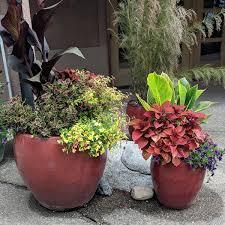
Container Gardening Guide, Elisabeth C. Miller LibraryContainer gardening may be the answer! More than just for areas with limited space, containers are great for adding height in an existing garden, as a way to plant areas with difficult in-ground soil conditions, or as a portable home for plants that cannot survive the winter months outdoors. They also allow gardeners an opportunity to experiment with combinations of colors and textures on a small scale before taking on a bigger planting.

Additionally, I use container gardens within my own landscape in order to create visual levels of plantings within my border, as well as an alternative to battling digging out and amending the hard clay soil.


Key considerations when gardening in containers: 

  1. Location: When determining where to place your containers, it is important to consider the amount of sunlight the location gets during the day. 

  2. Container: Containers should have adequate drainage and not be too much larger in size (around) than the combined area needed for the plants that will be planted in the container.

  3. Soil: The soil should be mostly a potting soil mix, that can be amended with organic material (compost, peat moss). When adding material to the potting soil, the soil and organic material should be well combined in order to have a uniform texture and allow for proper drainage. 

  4. Plant selection: Based on the amount of sun that the container will get during the day, select plants that have similar amounts of sunlight and water required. 

Container Gardening, Too! Webinar | Cooperative Extension | The University  of Arizona

How to Design a Container Garden:

Designing a container garden lets the gardener be free to create playful and eye-catching garden spaces. 

The primary design elements of a container garden are the thrill, fill, and spill

  1. The thrill is usually a planting that creates height in the container, it is a planting that is often centered in the container and is taller than the rest. 

  2. The fill is a plant or plants that are similar in height, but shorter than the thrill. The fill occupies the middle section of the container planting and may have pops of color contrast that draw the eye toward the container. 

  3. The spill is typically a trailing plant that spills over the side of the container and adds both drama and texture.   

For plant recommendations and ideas, check out this list from Oregon State University.

Trying to decide which is right for you - container gardening or raised beds? Check out these five tips.

3 Ways to Enhance your Floral Arrangement Designs

Sunday, June 14, 2020

It's an Aphid Invasion!

Are you noticing an aphid invasion in your garden?


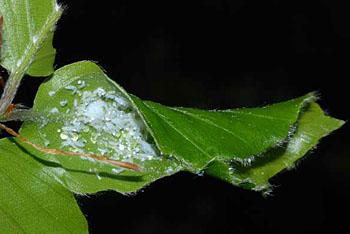
Aphids cause deformed and curled new leaves, buds, and flowers.  They can also carry viral diseases and some species cause galls. 


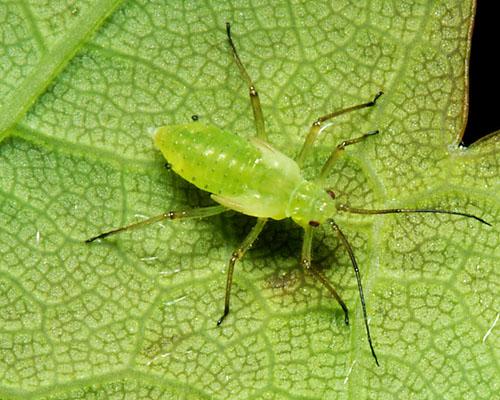
These soft-bodied, small round insects like to suck plant juices around the growing tips and tender tissues of plants.  


https://influentialpoints.com/Images/Euceraphis_nymph_accidental_on_sycamore_c2012-04-30_14-23-36ew.jpg

All aphids secrete honeydew, and this is sometimes the first symptom noticed. The honeydew attracts ants who feed on it.  You can find more information about these pesky, and destructive, garden pests at the University of Kentucky’s fact page.


https://influentialpoints.com/Images/Phyllaphis_fagi_aptera_and_nymphs_on_Fagus_sylvatica_at_Bank_New_Forest.jpg https://influentialpoints.com/Images/Phyllaphis_fagi_colony_leaf_folded_enclosing_colony_on_Fagus_sylvatica_at_Trinity_Hill.jpg

To manage aphid populations and their nuisance of destruction, soapy water (use specially formulated insecticidal soaps) sponged or sprayed onto leaves works well. Natural solutions can be predators like lady beetles and flower fly larvae. For additional information on biological, cultural, and chemical control options, check out the University of California or Colorado State University fact sheets on aphids.


Sunday, April 19, 2020

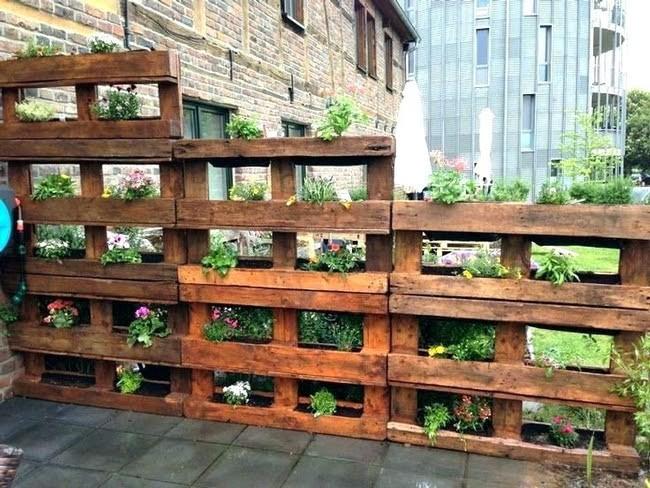
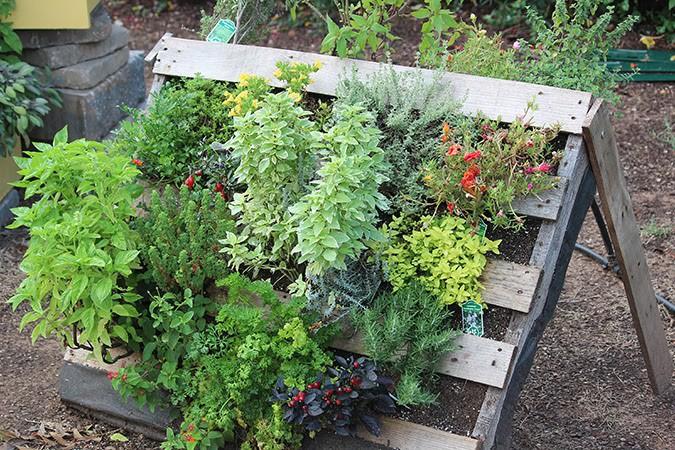
Vertical Gardening with Pallets


Have you always wanted a garden but didn’t think you had enough outdoor space? How would you like to grow your own ‘salad wall’? Not everyone has access to large garden spaces and cities are becoming more crowded and dependent on apartment living. By 2050, almost 80% of the earth's population will be living in urban areas.
Vertical pallet gardens or “green walls” are an innovative solution that has become quite popular! They are easy to create and very sustainable. Imagine being able to create a decorative succulent wall near your front door, or being able to have fresh vegetables right on your balcony! Vertical gardens help to reduce the carbon footprint by filtering pollutants and carbon dioxide out of the air, which improves our air quality.

Not only is pallet gardening fun and easy, below are a few benefits:
  • use your space more efficiently
  • conserve water
  • decrease insects and disease
  • reduce the need to weed
  • eliminate back pain by decreasing bending which is easier on your back, knees, and hips
Wood pallets are a perfect choice for your green wall. You can often find them for very little money, or even for free! You can choose to lean or hang your pallet on a wall or fence, or make a stand to hold it. See this video for a variety of pallet gardening examples.
When selecting plants for your vertical garden, choose plants with a shallow root system: lettuce, tomatoes, strawberries, cucumbers, arugula, spinach, chard, dwarf peas, parsley, bush beans, and kale. Herbs like rosemary, thyme, and basil are also perfect for pallet gardening as well.


It is important to know the right type of pallet to use. If you decide to grow food plants, use a pallet that is stamped “HT,” which means heat treated. This type of pallet does not have chemicals that can leach out into your garden. If recycling a used pallet, kill any bacteria that may be lurking inside by scrubbing down the wood with a bleach solution and then soapy water and let it dry before planting.
How to Build a Pallet Garden: See this video for a demonstration.
If you choose to line all 4 sides of the pallet with landscape fabric and cut holes in front for your plant, complete steps 1-3 first. If you choose not to, skip to step 4.
  1. Lay your pallet down horizontally, and use a staple gun to adhere landscape fabric to the pallet.
  2. Once you have 3 sides done, fill the pallet with potting soil. Press potting soil down firmly. 
  3. Staple the last landscape fabric to the front of the pallet.
  4. Transfer your plants while the pallet is still lying flat. It is a good idea to leave the pallet laying horizontally for 1-2 weeks to allow the young plants to take root. 
  5. When watering, start at the top and water each section a little less because the water will seep downward to the bottom of the pallet. Water frequently as plants will dry out quickly. 
  6. Fertilize your plants, as recommended specific to your plants, to provide them the nutrients they need to grow.