Thursday, March 30, 2023

Billbug Cause Major Damage to Lawns (Turf) in the Treasure Valley

Billbugs are small, snouted beetles that belong to the family Curculionidae and are considered to be major pests to lawns in the Treasure Valley. These pests are known for causing significant damage to turf grass and lawns, leading to unsightly brown patches and reduced aesthetic appeal. In this blog, we will discuss what billbugs are, their impact on turf grass, and how to control them using integrated pest management (IPM) methods.

What Are Billbugs?
Billbugs are cylindrical beetles that range in size from 3 to 10 millimeters in length, depending upon life stage. As adults, they have a hard exoskeleton and are usually brown or black in color. Their snout, which is often longer than their body, is used for boring into plant stems. Billbugs undergo a complete metamorphosis, passing through the egg, larval, pupal, and adult stages, with a one-year life cycle (Oregon State University Extension, 2018). The majority of damage from billbugs occurs during the larval stage, as they feed on stems, rhizomes, and crowns, typically just below the soil surface. Damage from billbugs is typically visible in late June or early July each year.

In the Treasure Valley of Idaho, billbugs are particularly abundant in lawns, parks, and golf courses. They feed on the stems and roots of turf grass, causing significant damage to the plant's ability to absorb water and nutrients. This feeding can lead to large areas of grass dying, creating unsightly brown patches that are not only aesthetically unpleasing but also difficult to repair (Idaho State University Extension, 2017).

Impact of Billbugs
The impact of billbugs on turf grass can be significant. In addition to the unsightly brown patches, Billbugs can reduce the health of the grass, leading to reduced aesthetic appeal and causing economic losses for lawn owners (Idaho State University Extension, 2017).

Integrated Pest Management (IPM)
Integrated pest management (IPM) is a comprehensive approach to managing billbug infestations that involves multiple control methods
. This strategy utilizes cultural, biological, and chemical control methods to promote the health of the turf and prevent billbug damage. Cultural control methods involve selecting the proper grass varieties that exhibit resistance to billbug feeding. Several cultivars of Kentucky bluegrass, such as ‘Park’, ‘Arista’, and ‘NuDwarf’, have been proven to exhibit resistance to billbug feeding. Additionally, endophyte-enhanced ryegrasses and fescues display high resistance to billbug feeding (University of Utah). IPM of Billbugs also includes implementing proper irrigation, fertilization, and mowing practices to maintain healthy turf. Biological control methods may involve releasing beneficial insects that feed on billbugs to control their population. Several nonchemical bio-pesticides exist, including purchasing and applying predatory nematodes (Stinernema & Heterorhabditis spp.), as well as a fungal organism (Beauveria bassiana) that are listed and registered for control of billbug larvae in lawns. When necessary, insecticides can be used to control billbugs, but should be used with caution to avoid harming beneficial insects and creating insecticide-resistant billbug populations (The University of Idaho Extension, 2017). 
Properly implemented IPM practices can effectively manage billbugs and maintain healthy turf.

Thursday, March 23, 2023

Early Spring Lawn Care

Spring is here! The days are getting warmer and longer. We look out at our lawn coming out of a long winter that has not been fed for a while. Its color is off and we think: if I hit it with lots of water, dump some fertilizer on it that will fix it. But wait… there are a few things to consider about feeding and watering your lawn before you start.

C:\Users\jbbow\AppData\Local\Microsoft\Windows\INetCache\Content.MSO\A278CA17.tmpWhen to Fertilize
A program that applies fertilizer four times a year, using the holidays of Easter, Memorial Day, Halloween and Thanksgiving as a guide is desirable. An application of a quick release formula, where the nitrogen is quickly available to the plants, is best in the spring and slow release formulas, where the release of nitrogen is slower can be used for the rest of the applications.  It is better if the late fall application is slow release so the nutrients are released into the soil during the winter to help with lawn recovery in the spring.
Image result for lawn fertilizerWhat Type of Fertilizer
The ratio of nutrients on any plant food is represented by Nitrogen- Phosphorus- Potassium (N-P-K) in numbers. The numbers state the amount of each. For instance, a 10-10-10 is a balanced food with equal parts nitrogen, phosphorus and potassium. A fourth number would represent Sulfur (S).
Nitrogen promotes foliar growth and color. Phosphorus is useful in encouraging flower and root growth. Potassium in lawns enhances the plant’s ability to use nitrogen.
Lawns in southern Idaho can be fertilized by following one of two strategies: soil testing or nutrient ratios. In one, fertilizer rates for the lawn are based on a laboratory analysis of a soil sample. The other is based on the fact that lawns do best when fertilized with a fertilizer having a 3:1:2: ratio of N, P, K.  Spring applications can use a ratio where the phosphorus ratio is higher to promote root growth.                                 
Watering
Water deeply and less often to promote deep roots. Apply between 1”-1 1/2” of water weekly, depending on weather conditions, soil type, and landscape terrain (slopes, etc.). Soil should be moistened to a depth of about six inches. To test sprinkler output, place empty tuna fish cans or cat food tins along the water arc to see how long it takes your sprinkler to put down this amount of water. Output is greater the farthest point from the sprinkler head. (You can allow the cans to fill 1/4” or 1/2” and multiple accordingly.) One application a week may be all that is necessary, or you can divide the time into two or three applications per week. Also, take into consideration the areas where sprinklers overlap an area, and that sprinkler output varies. During hot weather, increase the water to 2” per week and apply more frequently if necessary. Visual clues that the lawn needs watering are when the grass begins to take on a blue-green color or has lost its spring, leaving an imprint behind when walked upon.
Aeration
Core aeration opens up avenues for water and fertilizer to reach down to the root zone, thus stimulating the activity of soil microorganisms and increasing root development. Lawns that have not been aerated before or those that get heavy foot traffic may benefit by aerating twice per year, once in the spring and again in the fall for the first two or three years, then drop back to once per year. On lawns that are regularly core aerated once per year in the spring is enough. Do not rake up plugs afterwards, these are topsoil and will decompose naturally, mow over them and they will soon disappear. An application of no more than a ¼” of compost after spring aeration is beneficial for all lawns.
Thatch
Image result for lawnThatch is not caused by leaving grass clippings on the lawn, as is commonly believed. It is an accumulation of dead and partly decomposed leaves, stems and roots above the soil surface but below the green leaves. Up to 1/2 inch of thatch is beneficial, acting as natural mulch, insulating the soil, reducing water evaporation and soil compaction, and increasing the lawns spring and wear tolerance.
Too much thatch serves as a barrier preventing air and moisture from moving into the root zone of the plants, causing the turf to dry out much too rapidly. This provides a haven for insects and disease. If thatch is over 1/2 inch, power raking in early spring is advised. Power raking every year is not necessary and may actually damage the lawn.
Giving your lawn an application of a slow release fertilizer in the fall will give your lawn a jump-start in the spring.

Thursday, March 16, 2023

Pruning Correctly and Other Ways to Avoid Bitter Pit in Apples

Bitter Pit
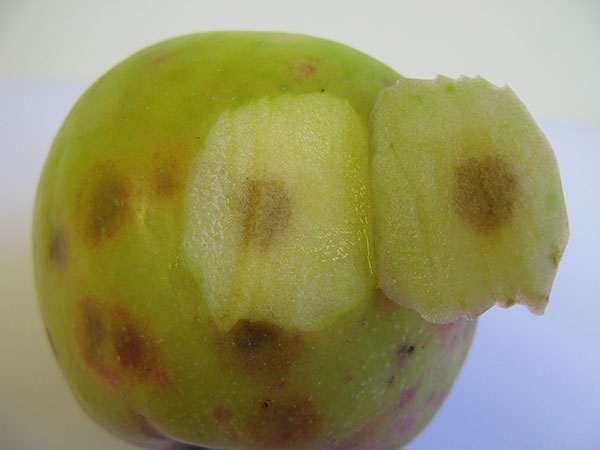
Imagine going out to harvest your apples only to find that all of your hard work has resulted in apples covered with brown sunken lesions on the skin, and brown spongy tissue below the skin surface. What caused this? Likely it was the result of a disorder called Bitter Pit!

Bitter pit can affect many apple varieties. The Granny Smith, Jonathan, Honeycrisp, Northern Spy, Gravenstein, Cortland, Fuji, Crispin, Empire, Ida Redd, and Baldwin are a few of the susceptible varieties. Rome Beauty, Winesap, Mackintosh, and Gala are all less susceptible varieties.

There are several things that can cause Bitter Pit, and a few different ways you can avoid or treat them.
  • Avoid wide fluctuations in soil moisture. Trees that have received too much or too little water are more prone to Bitter Pit. Mulch around the tree with a low nitrogen material to help retain moisture.
  • Do not over fertilize. Excessive nitrogen or potassium seem to coincide with Bitter Pit.
  • Do not over prune in the spring. Over pruning causes vigorous shoot growth. These shoots compete for calcium and it may result in Bitter Pit.
  • Do not over thin in the spring. Large apples from small crops seem to be more prone to Bitter Pit.
  • Late harvested fruit is prone to Bitter Pit. It can also develop if the fruit has been stored for a long time. Consider using the fruit quickly if bitter pit has been a problem in the past.
  • Calcium sprays should be applied carefully and according to packaging directions if none of the above methods works.
With a little extra effort and care you can avoid the dreaded Bitter Pit. It doesn’t take much effort and before you know it you will be harvesting the apple crop you always dreamed of.
Note: Bitter Pit can resemble damage caused by Stink Bugs. To learn more about Bitter Pit click here.

Thursday, March 9, 2023

Growing Shamrocks for St. Patrick's Day

Shamrocks have long been a symbol of Ireland and have even been considered a symbol of good luck. They are popular houseplants and fun gifts for friends and neighbors on St. Patrick’s Day. Shamrocks are easy to grow indoors if you follow these simple and easy to remember steps:

Light
Shamrocks prefer bright, indirect sunlight, be sure to place your plant in a window where it will receive plenty of light. Shamrocks will flower, even during winter, if they receive enough light. Each night the plant's leaflets fold up, then reopen in sunlight the following day.

Food
Shamrocks like food! Fertilize them regularly with either a liquid houseplant or a time-release fertilizer during their growing season. As always, we recommend following label instructions.

Soil
As a houseplant, they prefer moist soil. Avoid allowing your shamrock to dry out during the growing season.

Temperature
Give your shamrock a growing temperature between 50 and 70 °F during the growing season. They can be placed outside after danger of frost has passed and are a beautiful addition to your pots or in a grouping of pots.

Dormancy
Shamrocks have a dormant period. When your shamrock goes dormant, usually in late summer, don’t fret! Just place it in a cool, dry location out of direct sunlight for 2-3 months. The purple-leaf types only need one month of dormancy.

Since your shamrock grows from small bulbs, it is easy to divide and create new plants. Here's a short video showing how to propagate shamrocks.


Happy St. Paddy's Day to you!

Saturday, February 25, 2023

Before the Season is in Full Swing: Look to Your Tools!

We rely on our gardening tools for all of our gardening projects.
Tools are our helpers, but sometimes they can be our headaches. We hope the following tips will help your tools to be more friend than foe this gardening season.

Quality and Care Matters

In short, buy the best tools that you can afford. They will last for years with good care and maintenance. Your tools require regular care to condition wooden handles, to hold their edges, to be sharp, clean and sterile so they don’t accidentally spread disease. Tools should be occasionally oiled and stored in accessible locations where they can stay dry and rust free. A tool storage rack will “help prevent mutinies in the garden shed” by keeping tools organized, and may keep you safe from accidents. Always wear safety goggles and gloves when cleaning and sharpening tools.

Oiling
Tools need to be lubricated and protected from oxidation to prevent rust. Linseed oil and camellia oil are excellent protectants for metal and wood tools. Coat all wood surfaces with the oil and let it soak in for a few minutes. Give attention to moving parts and inner springs. Wipe away excess oil. The application of oil creates a barrier that reduces metal contact with oxygen and water. A heavier coating of oil on tools not being used in winter protects the metal during storage. 
Make an “oil sock” to rub metal parts and keep them clean. Stuff a sock with sand or wadded rags. Tie a knot and apply vegetable/canola oil. Store the sock in a zip-lock bag. Vegetable oils work best and are less toxic than the engine oil that’s often recommended.

Removing Large Debris
A “dip bucket” of sand can regularly clean shovels and trowels of clinging dirt. The older versions of a dip bucket with motor oil in the sand is hard to dispose of since it is considered hazardous waste. Linseed oil or mineral oil can be used instead.

Removing Sap
Murphy’s Oil Soap or a multipurpose hand cleaner removes plant sap from tools and is less toxic to use than turpentine which is recommended in older articles.

Disinfecting
To disinfect tools and pruning equipment both during use, and at season's end or beginning: spray or wipe with Lysol ® disinfectant. The active ingredients in Lysol® are less corrosive to metal than a bleach solution and easier on your garden clothes as well. There are other brands as well. Here's a link that discusses "The Myth of Cloroxed Clippers" and recommendations for the preferred disinfectant.


Let's keep our tools happy!

Thursday, February 16, 2023

Spring Greenhouse Prep

How did you close down your greenhouse last fall? Perhaps you are like most gardeners and left it in a bit of disarray from the scramble of fall garden cleanup that we all experience. It's okay, we have a few tips to help you get your greenhouse ready for spring!

First, we recommend removing everything from your greenhouse (overwintered plants, removable shelving, pots, trays, tools, floor mats, etc.) These items will be sanitized in another area. Do this in an open area with a breeze and sunshine, if possible.
  1. Start at the top of the greenhouse 
    Starting at the back and at the top of your greenhouse, working your way down and forward, will ensure you get every area in the greenhouse cleaned. Don’t forget to use a variety of brushes to clean the nooks and crannies where the panels connect to the frame, hinges on windows and doors, around vents, etc. Sweep the walls, clean the floor (soil or concrete) of all organic matter and weeds. 

  2. Flooring
    Floors, which can be made of many substrates, must be cleaned accordingly. There are concrete floors that can be scrubbed with a bleach solution. If the floor is dirt or rock, there will be weed maintenance as well as pest and pathogen procedures for the spring cleaning. Pull and discard any weeds that have sprung up to keep the potential pests and pathogens at bay. Whatever weed barrier you choose should be removed and replaced annually as well.

  3. Select cleaning agents and equipment 
    There are many choices when selecting cleaning equipment and agents: pressure washers with soap and water, Strip-it, etc. Be sure to read labels, talk to your garden center expert or a greenhouse supplier to help you decide. Rubbing alcohol can be used on knives and pruners. Although it is not recommended for the structure itself, household chlorine bleach is probably the least expensive and the easiest to obtain for a general disinfectant. Its half life is short; therefore, it should be mixed fresh, and items should be soaked for 30 minutes to be a thorough sanitizing. It Is used in a solution of 1 part bleach to 9 parts water. 

  4. Allow time to dry
    All items, including the structure, should be allowed to dry out completely by opening windows and leaving on fans before re-furnishing the greenhouse.

It is important that we keep our greenhouses clean to avoid pitfalls during the growing season.  

Have an amazing growing season!

Thursday, February 2, 2023

Asparagus – The Jewel of Spring

For those who enjoy asparagus, it may be the most anticipated spring vegetable to show up in the garden. This perennial plant has been a delicacy since Roman times and any home gardener can grow and enjoy this vegetable with some careful planning and preparation. 

Asparagus is a perennial that will produce for 10-15 years if it is planted and managed properly. Start by finding the perfect spot in your garden. Asparagus will need a permanent home with a sunny location and well-drained soil. It grows best in medium textured soils with a soil pH between 6.5-7.0.

Asparagus can be grown from seeds but most home gardeners choose to plant asparagus crowns purchased from seed catalogs or from local nurseries. When purchasing, review the varieties available. Hybrid varieties are mostly all-male plants with the open pollinated varieties containing male and female plants. The male varieties produce no seeds so all their energy goes into spear production which generates a higher yield of larger spears. The female varieties put their energy into seed production which generates a lower yield of smaller spears.

Your soil type will dictate the depth of your trench – medium textured soils dig a trench 8-10 inches deep; in heavy clay soils reduce trench to 6 inches and sandy soils increase trench to 12 inches. Place the crowns "head-to-toe" (bud-to-root tip) in a line down the trench, so the buds of the crowns are spaced above 12 inches apart and cover with 2-3 inches of soil. Rows of asparagus should be spaced at least 4 feet apart. Another method of planting is to place the crown in the trench on top of a small mound of soil, spread the roots out around the crown (“octopus” formation) then cover 2-3 inches with soil. Click here for growing guide.

As tempting as it may be, do not harvest asparagus spears the first spring after planting. Lightly harvest during the second spring then harvest normally in subsequent years.
At the end of the harvest, start getting your asparagus ready for next year. Continue to water regularly, control the weeds, and fertilize. Allow your last spears to go to ferns. When the ferns die down in the fall, mow them and leave them for mulch. 

Always be on the look-out for pests and diseases that can damage your asparagus.

The Asparagus Aphid, Asparagus beetle and the beetle larvae feed on leaves and above ground plant parts. The Cutworms, asparagus miner, and grasshoppers feed on the lower stem close to the ground and/or the roots. 

There are also a variety of diseases, such as Purple Spot, Rust, Fusarium Crown, Root and Lower Stem Rot and Phytophthora Crown, Root/Spear Rot which can affect the asparagus above and below the ground.

Your planning, maintenance and patience will be rewarded with numerous harvests of tender, green asparagus spears to enjoy every spring for years to come!